How to Run a Course Launch That Doesn't Fizzle
Jul 29, 2026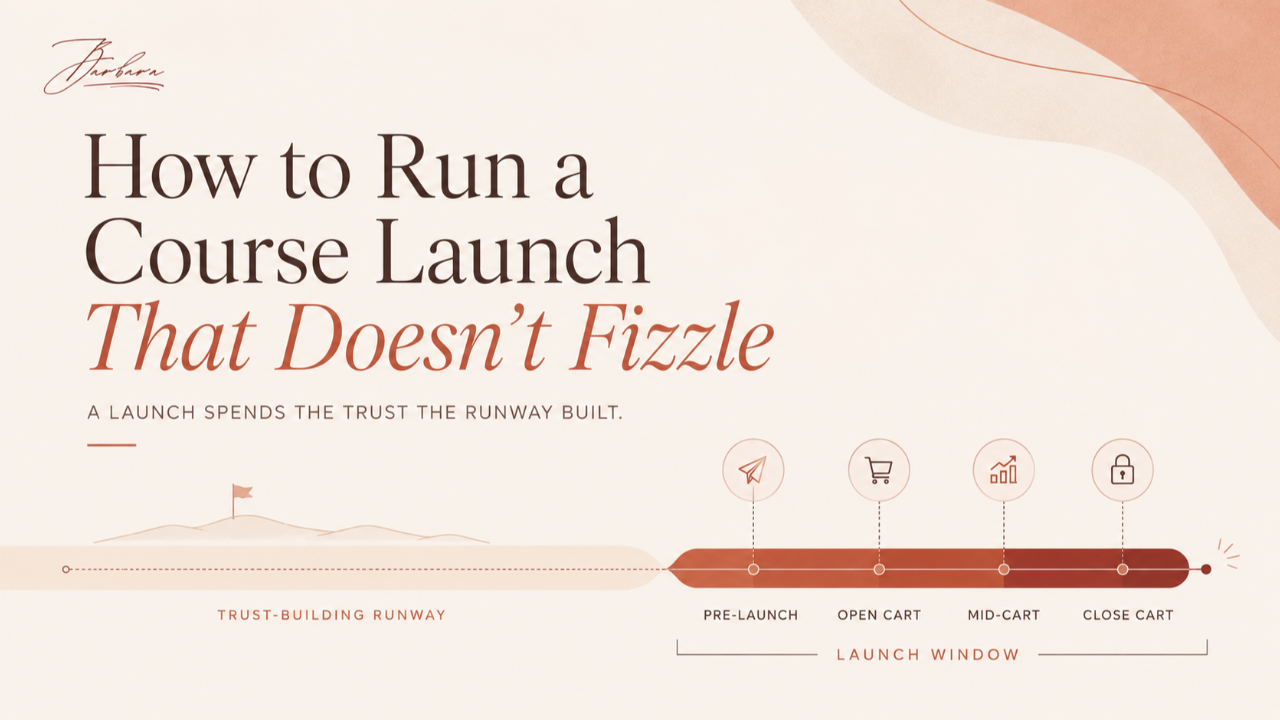
A launch that doesn't fizzle is built on a warm list and a real reason to act now, not on clever launch-week emails. A launch is where you spend the trust you built beforehand, so the outcome is mostly decided before the cart ever opens. The mechanics matter, a clear open, a sequence that leads with the outcome, objections handled through story, a genuine deadline, and a calm final push, but they only work on top of a warmed audience and a strong offer. Launch to a cold list or lean on fake urgency and even a perfect sequence falls flat.
That idea, that the launch is downstream of everything you did before it, is the thing that changes how you plan one. So it's worth understanding before we get to the mechanics.
A launch is the visible tip of everything underneath
In the seven layers of a course business, the launch is the sixth layer. It sits on top of the sales page, the offer, the email list, the lead magnet, and the niche. That makes it the moment everything below either pays off or shows its weak spot under pressure.
This is why a fizzled launch hits so hard and gets misread so often. You spent weeks preparing, you hit send, and the sales didn't come, so it feels like the launch failed. But the launch is rarely the thing that failed. It's the thing that revealed a lower-layer problem you couldn't see until it was under load. A cold list, a weak offer, a page that doesn't confirm the decision, these are invisible on a quiet Tuesday and glaringly obvious the moment you ask a few hundred people to buy at once.
So the launch is best understood as a stress test of the whole system, not as a standalone event you can win with better emails. When it goes well, it's because the layers underneath were ready. When it fizzles, the fix is almost always below the launch, not in it. That's exactly what the companion to this article, Why Did My Course Launch Fail?, walks through: a fizzled launch traced back to its real, lower cause.
The launch spends trust; the runway builds it
Here's the principle at the center of every launch that works. A launch does not create desire in a week. It collects on trust that was banked over the weeks and months before it, on what we call the runway.
The runway is all the value-first contact that came before launch week: the consistent, useful emails that made your list trust you and believe you over-deliver. When you open the cart, you're spending that trust. If the runway was long and well-fed, there's plenty to spend, and the launch converts. If there was no runway, if you went quiet and then reappeared to sell, there's nothing banked, and the launch fizzles no matter how good the sequence is.
This reframes the whole timeline. By the time you open the cart, the result is mostly determined. The most important launch work happens before launch week, in the warming, which is covered in full in How Email Turns Subscribers Into Buyers. It's also why a small warm list can out-launch a large cold one. Raw size is not what converts; banked trust is. A few hundred people who genuinely trust you will out-buy thousands who barely remember opting in.
So if you take one thing from this guide, take this: a launch is the spending phase, and the runway is the earning phase. Do the earning first.
The phases of a launch that converts
With a warm runway underneath, the launch sequence itself follows a predictable arc. Each phase has one job.
Pre-launch, before the cart opens. This is where you seed what's coming and deliver a burst of real value around the problem your course solves, without pitching yet. You're getting the audience leaning in, raising the problem to the surface so that when the offer appears, it answers a question they're already asking. A launch with no pre-launch asks people to go from zero to buying in a single email, which rarely works.
Open cart. When the cart opens, announce it clearly and lead with the dream outcome, not the product. People buy the result, not the six modules. Plan at least two emails here: the announcement itself, and a story-based one that handles the single biggest objection by showing someone who had that exact doubt and what happened. Remember that the email's job is to earn the click through to the sales page, not to close the sale in the inbox. The page does the converting.
Mid-cart. The people still undecided in the middle of the cart window usually have one specific concern each. So send roughly one email per major objection, and handle each as a story or a short case rather than a dry list of questions and answers. A narrative someone can see themselves in dissolves a doubt better than a bulleted rebuttal.
Close cart, the final push. The last 24 to 48 hours do a surprising amount of the work, because real deadlines move people who were genuinely interested but not yet moved. Send two or three emails here, and make the final one calm and direct rather than frantic. Send it on the last day, not the last hour, so the people who act on deadlines actually have time to act. A meaningful share of a launch's sales arrive in this closing window and in any replay, so design the close deliberately instead of letting the launch just trail off.
Notice that none of these phases is trying to manufacture desire. Each one is helping an already-warm audience make a decision they were primed to make.
Why launches fizzle
When a launch underperforms, the cause almost always sits below the launch layer. The usual suspects, in rough order of frequency:
You launched to a cold list. This is the most common cause by far. No runway, no banked trust, nothing to spend. The launch sequence was fine; the list was never warmed.
The offer underneath was weak or unclear. If warm people understood the offer and still didn't buy, the launch didn't fail, the offer did. That's a job for How to Build an Offer People Can't Ignore, not a better launch email.
There was no real reason to act now. Without a genuine deadline, people default to "later," and later usually means never.
You launched too soon, before the runway did its work. A rushed launch to a half-warm list spends trust that isn't there yet.
The sales page didn't confirm the decision. Even a warm, ready buyer can stall on a page that confuses rather than confirms, which is what The Anatomy of a Course Sales Page That Converts addresses.
If your launch fizzled and you're not sure which of these it was, the full diagnostic walk is in Why Did My Course Launch Fail?
Planning a launch that lands
Here's the sequence for running one, and the first two steps happen well before launch week.
- Warm the list first. The runway is the foundation. Give weeks to months of genuine, consistent value before you plan to open a cart. This is the single highest-leverage launch decision, and it's made long before the launch.
- Confirm the offer and page are strong. Don't launch on a weak skeleton. Make sure the offer is compelling and the sales page confirms cleanly before you open, because the launch only amplifies what's already there.
- Map the sequence. Lay out pre-launch, open cart, mid-cart, and close, with each email's one job decided in advance.
- Pick a real deadline. A cart that genuinely closes, a cohort that genuinely starts, or a bonus that genuinely expires. The deadline is the engine, and it has to be real.
- Handle objections through story. Across the sequence, dissolve the top hesitations with short narratives rather than a dry FAQ.
- Plan the close deliberately. Design the final push and any replay to capture late deciders, rather than letting the launch fade out.
The through-line: the launch is assembled on top of warm trust and a strong offer. It's never a substitute for them. If several layers beneath look shaky, What Should I Fix First in My Funnel? says to fix the lowest one first, and that's almost always more important than any launch tactic.
Urgency that's real, not manufactured
The deadline is the engine of a launch, which makes it the place people are most tempted to cheat. Resist that.
Real urgency is honest and it works: a cart that actually closes, a cohort that actually starts on a date, a bonus that actually goes away. These give a genuinely interested person a real reason to decide now instead of drifting to "later." That's not pressure, it's clarity about a real choice with a real deadline.
Fake urgency is the opposite. A countdown timer that resets when the page reloads, a "final hours" email followed by three more "final hours" emails, a cart that closes and mysteriously reopens, these train your audience not to believe you. And the cost isn't just this launch. It's every launch after, because once people learn your deadlines are fiction, your real deadlines stop working too. Manufactured urgency borrows against trust you'll want next time, at a terrible interest rate. If your launch only converts with invented scarcity, the problem is the offer or the runway, not the amount of pressure.
Common launch mistakes
- Launching to a cold list. The number-one cause of a fizzle. No runway, nothing to spend.
- Leaning on fake urgency or fake scarcity. It works once and poisons every launch after.
- Leading with the product instead of the outcome. People buy the result. Open with the transformation, not the module list.
- Handling objections as a dry FAQ. Story dissolves doubt; a bulleted Q&A rarely does.
- Sending the final email in the last hour. Deadline buyers need the last day, not the last sixty minutes, to act.
- Treating the launch as separate from the runway. The launch spends what the runway built. They're one system, not two.
- Judging your whole business on one launch's number. A single fizzle usually points to one fixable lower layer, not a doomed business.
Where the launch sits in the system
The launch is the sixth layer, sitting above the sales page and the offer and below only traffic. During the open window, it drives a concentrated wave of warm traffic to your sales page, which is its real mechanical job: it concentrates attention and creates a reason to act now. But it can only convert what the layers beneath it prepared.
That's why launch failures trace downward so reliably. The pain shows up at the launch, the most visible, most emotionally loaded moment, but the cause is almost always lower: a cold list, a weak offer, or a sales page that doesn't confirm. It's the same lesson that runs through the whole framework, that the symptom is rarely the problem and usually sits a layer or more below where it hurts. If you want the full system, How to Diagnose Why Your Course Business Isn't Selling walks all seven layers in order, and Why Is My Online Course Not Selling? is the short way in.
The short version
A launch that doesn't fizzle spends trust it didn't create during launch week. Warm the list on a long runway, confirm the offer and page are strong, then run a clean sequence, pre-launch, open, mid-cart, close, with a real deadline and objections handled through story. The mechanics matter, but they only work on top of a warm audience and a strong offer. Get those right first, and the launch has something real to spend.
Before your next launch, run the free Course Business Diagnostic to make sure the layers beneath it are ready, so the launch has something to spend.
Take the free Course Business Diagnostic
FAQ
How long should a launch be? The open-cart window is usually short, often around five to seven days, because a deadline only creates urgency if it's close enough to feel real. But the launch as a whole is much longer than the cart window, because the runway that makes it work runs for weeks or months before. If you're asking only about how many days the cart stays open, a week is a common, workable length; the more important length is the runway before it.
How big does my list need to be to launch? Smaller than most people assume, because warmth matters far more than size. A few hundred genuinely engaged subscribers who trust you can produce a real launch, while a large, cold list often produces almost nothing. Don't wait for some big subscriber count before you launch; wait until the list you have is warm. A small warm list out-launches a large cold one every time.
How many emails should I send during a launch? More than feels comfortable, spread across the phases: a few in pre-launch, two or so at open, one per major objection mid-cart, and two or three at close. Many creators under-email out of fear of annoying people, and lose sales from subscribers who simply missed the one message they sent. As long as the emails carry value or move the decision forward, sending through the whole window helps more than it hurts.
Should I launch live or run it evergreen? Both can work, and the choice is a trade-off. A live launch concentrates attention and carries a naturally real deadline, which is powerful but effortful and periodic. An evergreen launch runs continuously and steadily, but its urgency has to be genuine rather than a fake per-visitor timer, or it erodes trust. Many creators start with live launches to learn what converts, then build an evergreen version once they know the sequence works.
My last launch flopped, what do I fix first? Look below the launch before you touch the launch itself. The most common cause is a cold list, so ask first whether you warmed the audience with a real runway. If the list was warm, check the offer, then the sales page. Resist the urge to just rewrite launch emails, because a fizzle almost always points to a lower layer. The full walk-through is in Why Did My Course Launch Fail, and the diagnostic will pinpoint the layer.