How to Diagnose Why Your Course Business Isn't Selling
Jul 27, 2026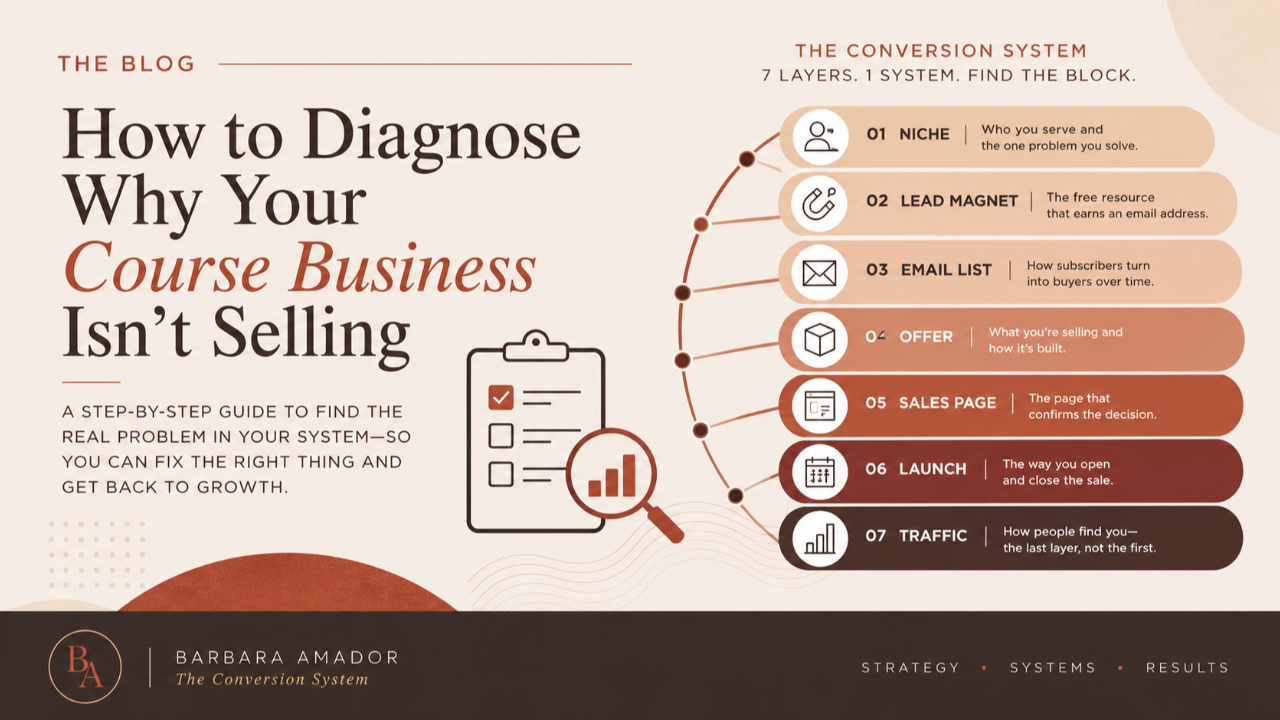
To diagnose a course business, you check its seven layers in order, from the foundation up, and stop at the first one that isn't working. Those layers are niche, lead magnet, email list, offer, sales page, launch, and traffic. Each layer depends on the ones before it, so a problem in an early layer creates symptoms further up, which means the fix is rarely where the pain shows up. The point of a diagnosis isn't to improve everything at once. It's to find the single layer that, once fixed, lets everything above it start working.
Why guessing is the expensive option
When a course isn't selling, most people reach for whatever's in front of them. They rewrite the sales page. They tweak subject lines. They buy ads. Each of these can feel like progress, and each one costs time or money, but they all share the same flaw: they assume the problem is where the symptom is.
It usually isn't. A course business is a connected system, and in a connected system the thing that hurts is often not the thing that's broken. A quiet launch might have nothing to do with your launch emails. A sales page that won't convert might have nothing to do with the page. Until you know which layer is actually stuck, every fix is a guess, and most guesses are wrong.
A diagnosis replaces guessing with a sequence. Instead of asking "what should I improve," you ask "which layer is the bottleneck," and you answer it in a fixed order that respects how the system is built. That's the difference between working hard and working on the right thing.
The Conversion System: seven layers in order
The Conversion System is the seven-layer framework I use to find where a course business is stuck. The layers run from the foundation up, and the order is not decorative. Each layer depends on the ones beneath it, so a weak lower layer starves everything above it no matter how strong those upper layers are.
Here are the seven, in order.
Niche. Who you serve and the one problem you solve. This is the foundation, because every other layer inherits its clarity or its vagueness. If the niche is too broad, the messaging goes soft, the lead magnet attracts the wrong people, and the whole system strains to compensate. How to Choose a Course Niche That Actually Sells covers how to get it right.
Lead Magnet. The free resource that earns an email address. Its job is to bring in the right people and give them a real result, fast. If it's too generic, it either fails to convert visitors or fills your list with people who were never going to buy. What Makes a Lead Magnet Actually Convert covers how to build one that works.
Email List. How subscribers turn into buyers over time. This is the trust layer. A list that's engaged buys when you make an offer; a list that's just sitting there does not, regardless of how good the offer is. How Email Turns Subscribers Into Buyers covers how to warm it.
Offer. What you're actually selling and how it's built. A surprising share of problems that look like copy or traffic actually live here. If the offer isn't compelling enough at its price, people understand it perfectly and still say no. How to Build an Offer People Can't Ignore covers how to design one that converts.
Sales Page. The page that confirms a decision the reader has mostly already made. When everything below it is working, the page's job is small: remove the last hesitation. When the layers below it are broken, no amount of page polish saves it. The Anatomy of a Course Sales Page That Converts covers how to build one.
Launch. The way you open and close the sale. A launch works when the list is warm and there's a real reason to act now. It fails when you launch to a cold list or manufacture urgency that isn't real. How to Run a Course Launch That Doesn't Fizzle covers how to run one that lands.
Traffic. How people find you. This sits at the top on purpose. Traffic multiplies whatever the system below it already does, so adding traffic to a working system grows it and adding traffic to a broken one just grows the losses. Why Traffic Is the Last Thing to Fix covers why it comes last and how to approach it.
Read that list from the bottom up and you can feel the dependency. Niche feeds the lead magnet. The lead magnet feeds the list. The list feeds the launch. Traffic feeds all of it. That's why you diagnose in this order, and it's the single most important idea in this whole guide.
Reading the symptom without trusting it
The reason people misdiagnose their own business is that symptoms are honest about where they hurt and dishonest about why. The same symptom can point to several different layers.
Take "my sales page isn't converting." That could be the page. It could also be the offer behind the page, or a list that was never warmed, or a niche so broad that the wrong people are reading it. Four different layers, one symptom.
Or take "my launch flopped". That could be the launch sequence. It could just as easily be a cold list, which traces back to a lead magnet that brought in the wrong subscribers, which traces back to a fuzzy niche. Same symptom, a chain of possible causes running three layers deep.
So treat a symptom as a clue, not a verdict. It tells you something is wrong and roughly where to start looking. It does not tell you what to fix. The skill is holding the symptom loosely enough to trace it back to its actual source. This is the idea the whole framework runs on: The Symptom Is Rarely the Problem.
The diagnostic sequence, step by step
Here's the sequence you can run on your own business. Work from the bottom up, and stop at the first layer that fails. That first failure is your diagnosis.
-
Niche. Is your niche specific enough that one real person would read your first sentence and think "this is me"? If your messaging could describe a dozen different people, the foundation is soft, and you've likely found your bottleneck already.
-
Lead magnet. Are the right people opting in, at a reasonable rate? If few people opt in, or if plenty opt in but they never buy anything later, the lead magnet is either too weak or attracting the wrong audience.
-
Email list. Is the list engaging with you, or just existing? Opens and clicks and replies are signs of a relationship. Silence means the trust layer isn't being built, and selling to that list will feel like shouting at strangers.
-
Offer. When warm, engaged people see what you're selling, do they understand it and still not want it enough at the price? If so, the offer is the problem, and no better sales copy will fix it. Strengthen what you're selling before you touch how you describe it.
-
Sales page. Do warm, ready people land on the page and leave without acting? Only once everything beneath it is working can you trust that a low-converting page is actually about the page.
-
Launch. Is there a real reason for people to act now, and was the list warmed before you launched? A launch to a cold list underperforms no matter how well the emails are written.
-
Traffic. Only after all six layers below are working do you ask whether the real constraint is simply not enough of the right people arriving. If the system converts and you just need more of it, now traffic is the answer. Before that, it's an expensive distraction.
Stop at the first layer that fails. You don't need to run all seven every time. The first break is the diagnosis, and everything above it is probably a symptom of it. If you want this sequence broken down into a hands-on test for each layer, with what a healthy and a broken version of each looks like, How to Find the Bottleneck in Your Course Business walks through it layer by layer.
If you'd rather not run this by hand, the free Course Business Diagnostic walks you through this exact sequence, layer by layer, and tells you the first one that's stuck.
What a diagnosis changes about your next move
The payoff of a diagnosis isn't only knowing what to work on. It's knowing what to leave alone.
Imagine a creator who's convinced she has a traffic problem. Sales are slow, so more visitors seems like the obvious answer. She runs the sequence and finds that her list is warm and engaged, people are reaching her sales page, and they're leaving without buying. The layers below the offer are fine. The offer is where it breaks. Warm people understand it and still say no.
That changes everything about her next move. Buying traffic would have poured money into sending more people to an offer that already wasn't landing. The diagnosis tells her to rebuild the offer first, and to not spend a dollar on ads until it converts. Knowing what not to do saved her the entire ad budget.
That's what a diagnosis buys you: not just a direction, but permission to stop working on the wrong things.
Common mistakes when diagnosing
- Diagnosing from the top down. Starting at traffic or the sales page, where the pain is loudest, instead of at the foundation. You'll keep finding surface problems that were caused lower down.
- Fixing more than one layer at once. Change three things and you won't know which one worked, or whether you fixed the real problem or just added noise.
- Trusting the symptom. Treating "the page won't convert" as "the page is broken" without tracing it back.
- Concluding traffic by default. Traffic is the most common wrong answer, because it feels like the one thing you can always do more of.
- Re-diagnosing forever. At some point you stop analyzing and fix the first break. A diagnosis you never act on is just worry with a framework around it.
How the layers depend on each other
Everything in this guide rests on one fact: the seven layers are connected, in order. That's the only reason a bottom-up diagnosis works. If the layers were independent, you could fix them in any order and the symptom would always name the cause. They aren't, so it doesn't.
A sales page that won't convert can be an offer that was never compelling. A launch that misses can be a list that was never warmed, which can trace back to a lead magnet that attracted the wrong people, which traces back to a niche that was too broad. Pull almost any thread and it leads earlier in the system. This is why you diagnose before you optimize, and why you fix the right part of the system first instead of the part that's shouting loudest.
Two questions come up so often they have their own guides. If you're stuck deciding whether your problem is upstream or just a lack of visitors, start with Do I Have a Traffic Problem or a Conversion Problem?. If you've found more than one weak spot and don't know where to begin, read What Should I Fix First in My Funnel?. And if you want the plain-language version of why courses stall in the first place, Why Is My Online Course Not Selling? is the shortest way in.
The short version
Diagnosing a course business is simple to state and disciplined to do. Check the seven layers in order, from the foundation up. Stop at the first one that fails. Fix that, and only that, before you judge the result. The layer that's stuck is usually not the layer that hurts, which is exactly why the sequence matters.
If you want the guided version, the free Course Business Diagnostic runs this whole sequence for you and tells you the first layer to fix.
FAQ
What is a course business diagnostic? It's a structured way to find the one layer of your course business that's holding back your sales, instead of guessing or fixing everything at once. Rather than giving you a score, a good diagnostic checks the seven layers in order and points to the first one that's broken. That's the layer to fix first.
How often should I diagnose my course business? A useful habit is to run the diagnosis before any launch, not only after a disappointing one. A system you check regularly rarely breaks in a launch, because you catch the weak layer before it costs you. Re-running it after a major change to your offer, list, or audience is also worthwhile, since fixing one layer can shift where the next constraint sits.
Can I have more than one broken layer at the same time? Often, yes. But you still fix them one at a time, from the bottom up, because a lower broken layer distorts your read on the higher ones. Fix the first break, let the system settle, then diagnose again. The second problem sometimes shrinks or disappears once the first is solved.
Do I need any tools or data to diagnose my business? Basic numbers help: your opt-in rate, your email open and click rates, and whether people reaching your sales page are buying. But you can get surprisingly far just by walking the seven layers honestly and noticing the first place your answer turns from "yes, that's working" to "well, not really." The honesty matters more than the dashboard.