How to Write a Sales Page for Answer Engine Optimization (AEO)
Aug 26, 2026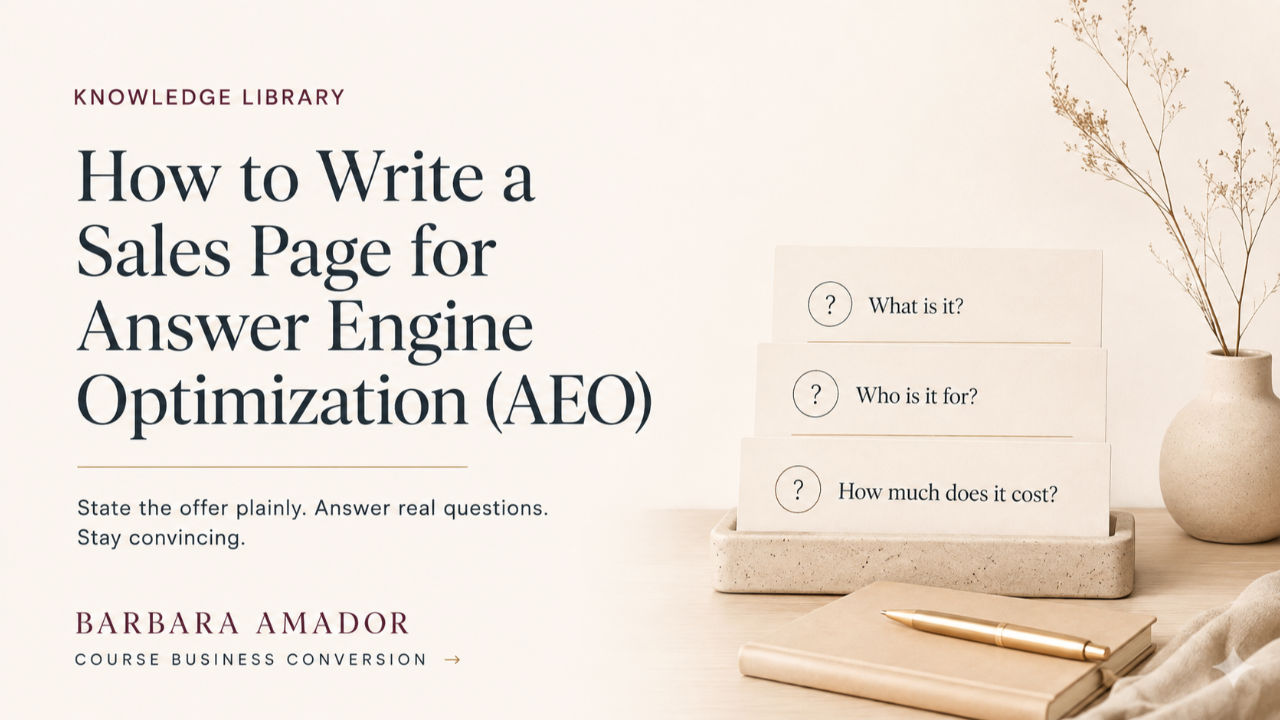
Type a question about a course topic into ChatGPT or Perplexity, and the answer often comes back with a name attached: a program, a person, a resource that already stated things plainly enough to quote. Whether your sales page is one of the pages a system reaches for isn't decided by a trick or a plugin. It's decided by whether the page states, in plain language somewhere on it, exactly what a person would need to know to describe your course to someone else. Everything below is about how to do it without turning the page into something a machine likes and a buyer doesn't.
Start from the sales page you already know how to build. The Anatomy of a Course Sales Page That Converts covers the sections and the order: headline, problem, offer, proof, objections, guarantee, call to action. Everything here sits on top of that structure. None of it replaces it.
The habits that make a page answerable
A few habits show up across how answer engines are actually built to read a page, and they apply whether the reader is a person skimming or a system trying to extract a fact.
- Front-load the answer. State the key fact, plainly, in the first sentence of a section, before the context and the color. A reader deciding whether to keep going and a system deciding whether to quote you are both looking for the same thing first: the answer, not the windup.
- Say every claim the same way, everywhere on the page. If the price, the format, or what's included reads differently in three spots, a reader has to guess which one is current, and a system has nothing consistent to lift. State it once, clearly, and repeat that exact version.
- Match your headers to the question a reader actually has. "What's Included" answers a real question. "The Details" doesn't tell anyone anything until they read further. Headers phrased as the reader's own question, in their own words, are easier for both a skimmer and a system to match to what they're looking for.
- Write in short, self-contained chunks. A paragraph that only makes sense with three paragraphs of setup before it is hard for a system to lift cleanly, and it's not much easier for a reader in a hurry. Aim for two to four sentences that hold together on their own.
- Build a real FAQ, in actual question-and-answer form. Not five generic questions bolted onto the bottom of the page. The real questions your buyers ask, answered directly in the first sentence, then elaborated in a line or two. A generic FAQ is formatting. A real one is a source.
Schema markup, the technical tagging that labels a page's FAQ or article structure for machines, can help a system parse a page a little faster. It's worth adding if you or your web person can do it without much friction. But it can't manufacture clarity that isn't there. A page with a confusing offer and clean markup underneath is still a confusing offer, so get the plain language right first.
Walking the anatomy again, with a system reading over the shoulder
The seven sections that make a sales page convert are the same seven sections that make it answerable. Here's what changes at each one.
The headline. It already has to name the outcome in the buyer's own words. For AEO, that same sentence is often the one line a system pulls when it's deciding whether to mention you at all. A headline that leans entirely on a clever hook, with the actual outcome implied rather than stated, gives a system nothing to grab. Keep the hook if it's working, and put the plain statement of outcome somewhere in that first section too.
The problem and the stakes. This section can stay exactly as emotionally resonant as it already is. The one addition: say plainly, somewhere near the top, who this is for. "For course creators whose launch numbers don't match the effort they put in" tells a reader and a system the same thing a vague opening story doesn't.
The offer and what's included. This is the section most worth tightening. Give the offer one complete, plain statement, what it is, what's included, the format, the price, somewhere on the page, and don't let a second mention elsewhere contradict it. Inconsistent details across a page are one of the more common reasons a system misdescribes an offer instead of skipping it entirely.
Proof. Named results and specific numbers read as more trustworthy to a person and are easier for a system to lift accurately than a vague "life-changing" testimonial. This is the same principle behind placing proof next to the doubt it answers; it just also happens to make the page more citable.
Objections and FAQ. Handle the real emotional hesitations through story, the way you already do. Then give the factual questions, how long is access, is this for beginners, what if I fall behind, their own honest FAQ section, phrased as the actual question and answered directly. This is the single highest-leverage AEO habit on the whole page, because direct-answer FAQ format is close to exactly what these systems are built to extract.
The guarantee. State the specific terms plainly. A guarantee described the same clear way everywhere it appears is one more consistent fact a system can rely on, and one more thing a hesitant buyer doesn't have to hunt for.
The call to action. No real change here. One clear next step, stated the same way each time it appears.
What this doesn't require
A few things worth ruling out before you spend time on them.
It doesn't require a shorter page. A long page with the answer easy to find works fine. A short page that dodges the actual question still fails. Length was never the lever, clarity is.
It doesn't require schema markup to function. It can help, and it's reasonable to add if it's easy for you, but plenty of pages get read and cited accurately with none. Don't let a technical checklist stand in for the plain-language work.
It doesn't require adding an FAQ section that isn't already true to how your buyers talk. A handful of generic questions added because a checklist said so reads as filler to a person and doesn't answer anything specific enough for a system to use either.
A sales page has a harder job than a blog post
Worth saying plainly: most AEO advice is written for blog and informational content, where the entire job is answering a question well. A sales page has to do that and still walk a warm reader to a yes, which is a different, harder job. Optimize too hard for machine legibility, strip out the story, flatten the voice, and you can end up with a page that reads clearly to a system and convinces no one. The habits above are additions to a page that already does its real job, not a replacement for it. If you're ever choosing between a sentence that converts and a sentence that's easier to extract, keep the one that converts.
It's also worth being honest about what a page controls and what it doesn't. A clear page controls what a system finds if it reads you directly. It doesn't control whether other people are mentioning you elsewhere, in reviews, roundups, or comparison posts, which is a separate part of how these systems form an answer and isn't fixed by rewriting your own page.
Common AEO sales-page mistakes
- Chasing schema before the copy is clear. Markup can't fix an offer that isn't stated plainly anywhere on the page.
- Bolting on a generic FAQ. Five questions nobody actually asks don't help a reader or a system. Use the real ones.
- Letting the same detail read differently in two places. Inconsistent claims are how a system ends up describing your offer wrong.
- Assuming shorter always wins. A clear long page beats a vague short one. Length isn't the variable that matters.
- Flattening the page's voice to sound more "answerable." A page that reads like a manual can be easy to extract and still fail to convert a single warm reader.
The short version
A sales page becomes answerable the same way it becomes convincing: state the offer plainly, say it the same way everywhere, and answer the real questions a buyer has, directly and early. None of that is a new structure. It's the anatomy you already build, with a habit of front-loading the plain answer at each section. Skip the schema debate until the language is right, keep the length that actually earns it, and don't sand the voice off the page chasing a citation. A page a person can understand at a glance is usually a page a system can too.
If you're not sure whether your page is actually stating the offer plainly, or just feels like it should be, the free Course Business Diagnostic finds the layer that's actually holding you back.
Take the free Course Business Diagnostic
FAQ
Do I need schema markup for AI to cite my sales page? No. It can help a system parse the page a little faster, and it's worth adding if it's low-effort for you, but it isn't required and it can't create clarity that isn't already in the copy. Get the plain-language statement of your offer right first.
Does my sales page need to be shorter to get cited by AI? No. Length isn't what decides whether a page is answerable. A long page where the answer is easy to find works fine. A short page that never states the offer plainly still fails, so don't cut content purely to hit a word count.
Is adding a generic FAQ section enough? No, and it can read as filler if the questions aren't ones your buyers actually ask. Pull real questions from your inbox, your DMs, your sales calls, and the comments on your content, the same source material behind how to do voice-of-customer research, and answer those directly.
How do I find the real questions to answer on the page? Look at what people actually ask you before they buy, in DMs, on discovery calls, in comments under your content. Those are the honest questions, in their own words, and they make a far stronger FAQ than anything guessed from a keyword tool.
How do I know if any of this is working? Ask an AI system the real questions a buyer would ask about your topic and see whether you come up, and check your analytics for referral traffic from AI sources. Treat what you find as one more data point, not a verdict, since being mentioned elsewhere on the web plays a part too, and that's outside what your own page controls.