How to Do Voice-of-Customer Research
Jul 30, 2026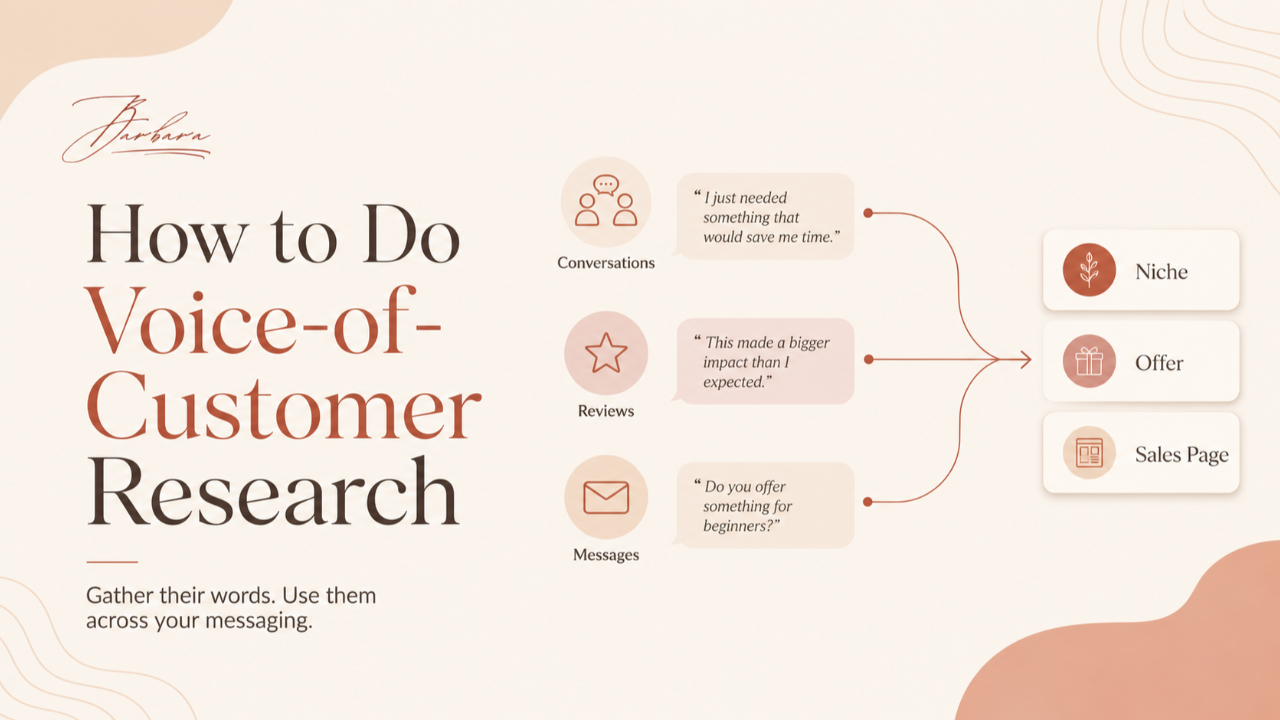
Voice-of-customer research is the practice of collecting the exact words your buyers and ideal customers use to describe their problem, their goal, and what they've already tried, then using those words in your niche, offer, and sales copy. The point isn't to invent better language; it's to mirror language that already exists in your audience's head, so your messaging feels like it was written from inside their experience. You gather it from conversations, surveys, reviews, and the words people use when they email you, and you use it verbatim, because the words that convert are almost always the customer's, not yours.
That idea, that the best words are ones you collect rather than ones you write, is what makes voice-of-customer research so useful and so different from ordinary copywriting. Let's look at how to do it.
The words that convert are already in your audience's head
Most messaging is weak for one reason: it's written in the creator's language instead of the customer's. You know your topic deeply, so you describe it the way an expert would, in terms of solutions, methods, and features. But your buyer doesn't think in those terms. They think in terms of the problem that's bothering them, in the plain words they'd use with a friend. When your messaging speaks expert and they think in symptoms, the two never quite meet.
Voice-of-customer research closes that gap by sourcing the words from the people you serve. Instead of guessing how to describe the problem, you go find how they describe it, and you use that. This feeds the whole foundation of your business: a niche described in the buyer's words so the right person feels found, an offer framed around what they actually said they want, a sales page headline that echoes their own phrasing back to them. It's the raw material that makes the lower layers sharp, which is why How to Choose a Course Niche That Actually Sells leans on it and why fixing flat messaging so often starts here.
Mirroring, not inventing
Here's the reframe that makes this work. Clever copywriting tries to craft persuasive language from scratch. Voice-of-customer research does the opposite: it finds language that already resonates, because the customer already thinks it. Your job is collection and mirroring, not invention.
This matters because invented language, no matter how polished, is a guess about what will land. Collected language isn't a guess. It already landed, with the person who said it, which is exactly why it will land with others like them. When a reader sees their own words reflected back on your page, something clicks: this person gets it. And feeling understood is what earns you the right to sell. Nobody buys from someone who seems to misunderstand their problem, and nobody feels understood by language that was written from the outside.
So the mental shift is from "how do I describe this well" to "how do they describe this already." The second question is answerable by research, and its answers convert better than anything you'd write on your own.
Where the words live
Voice-of-customer language is already out there, waiting to be collected. Here's where to find it, and what each source is good for.
Conversations and interviews. The richest source by far. Talk to real people in your audience and ask about the problem, what they've tried, and what they want, then listen for the exact phrasing. A few genuine conversations beat any amount of guessing, and you'll hear patterns repeat surprisingly fast.
Surveys. Good for gathering open-ended answers at scale. The gold is in the free-text responses, not the multiple choice, so always include questions people answer in their own words. The checkboxes tell you what; the sentences tell you how they say it.
Reviews and testimonials. Your own, and those of adjacent or competing products. In reviews, people describe their problem and their desired outcome plainly and emotionally, because they're talking to other buyers, not to you. It's some of the most honest language you'll find.
Your inbox and messages. The questions and complaints people already send you are voice-of-customer data you're sitting on. Every "I'm struggling with..." email is a phrase worth saving.
Communities and forums. Where your audience talks to each other, unfiltered by you being in the room. The way they describe the problem to a peer is often blunter and truer than the way they'd describe it to you.
Across all of these, the discipline is the same: collect the exact phrasing. Don't paraphrase it into something tidier as you go, because the tidying is where the resonance leaks out.
The four things worth capturing
As you gather, listen for four specific things. Capture each in the person's own words.
The problem, in their words. How do they describe the pain itself? Not your clinical name for it, their lived description of it.
The desired outcome, in their words. What does "solved" look like to them? What are they actually reaching for?
What they've already tried, and why it didn't work. This surfaces their objections and the false solutions they've burned time on, which is exactly what your messaging will need to address.
The stakes. Why does this matter to them? What is the problem costing them, in time, money, stress, or missed opportunity?
These map straight onto the layers of your business. The problem and the outcome feed your niche and your offer. What they've tried and rejected feeds your objection handling. The stakes feed the emotional core of your sales page. You're not just collecting nice quotes; you're gathering the specific raw material each layer needs.
Putting the words to work
Collected language is only useful once it's in your messaging. Here's where each kind of captured word goes.
Your niche. Describe who you serve and the problem you solve in their words, so the right person reads your first sentence and recognizes themselves. This is the heart of choosing a niche that actually sells.
Your offer. Frame the outcome your offer delivers around what buyers actually said they want, not around the features you find interesting. How to Build an Offer People Can't Ignore is built on delivering the outcome the buyer is really after.
Your sales page. Pull the headline straight from the way buyers describe their desired outcome, and handle objections using the exact concerns they raised. The Anatomy of a Course Sales Page That Converts uses the buyer's language at every step.
Your lead magnet and emails. Promise the quick win in their words, and write emails that sound like the problem they actually have. What Makes a Lead Magnet Actually Convert and How Email Turns Subscribers Into Buyers both land harder when the language is theirs.
The one rule that ties it together: use the words verbatim where you can. The instinct to "improve" a customer's rough phrase into polished marketing language is the instinct to resist, because the rough version is the one that already resonated.
Common voice-of-customer mistakes
- Guessing the words instead of gathering them. Writing what you assume they'd say skips the entire point. Go collect the real thing.
- Paraphrasing real phrases into marketing-speak. Polishing a customer's blunt phrase usually kills the resonance that made it worth using.
- Only talking to buyers. The people who didn't buy, or who left, often have the most useful language about objections and gaps.
- Asking leading questions. Questions that put words in their mouth get you your words back, not theirs. Ask open questions and let them fill the space.
- Collecting once and never again. The language shifts as your audience and market change. Treat it as ongoing, not a one-time project.
- Using demographics as a substitute for language. Knowing someone's age and job title tells you nothing about how they describe their problem. Only their words do that.
Where voice-of-customer sits in the system
Voice-of-customer research isn't one of the seven layers. It's the raw material that makes the lower layers sharp. It feeds the niche, the offer, the sales page, the lead magnet, and the emails with language that already resonates, because it came from the people those layers are trying to reach.
This is why a weak spot in any of those layers is so often, underneath, a voice-of-customer problem. A niche that feels vague, an offer that doesn't land, a page that doesn't convert, quite often the real issue is that the messaging was written in the creator's words instead of the customer's. Fixing the language at the source can lift several layers at once. If you're not sure which layer your flat messaging is actually hurting, How to Diagnose Why Your Course Business Isn't Selling walks the whole system, and Why Is My Online Course Not Selling? is the short way in.
The short version
Voice-of-customer research is gathering the exact words your customers use, then selling in those words. Collect the problem, the desired outcome, what they've tried, and the stakes, all in their phrasing, from conversations, reviews, surveys, and your own inbox. Then use those words verbatim across your niche, offer, and sales page. Mirror the language that already resonates instead of inventing your own, and your messaging starts to sound like it was written from inside your buyer's head, because it was.
If your messaging feels flat and you're not sure which layer it's hurting, the free Course Business Diagnostic finds where the system is actually stuck.
Take the free Course Business Diagnostic
FAQ
How many customer interviews do I need? Fewer than you'd expect, because patterns repeat fast. After a handful of real conversations with the right people, you'll start hearing the same phrases and frustrations come up again, and that repetition is the signal you're capturing something real rather than one person's quirk. There's no magic number, but a few focused conversations beat a big survey of shallow answers. Keep going until new interviews stop surprising you.
What questions should I ask in a customer interview? Open ones that invite their own words: what were you struggling with before you looked for a solution, what had you already tried, what did you want to be different, and what would have happened if you hadn't solved it. Avoid yes-or-no questions and anything that suggests the answer. Your goal is to get them talking in full sentences about their experience, then to listen for the exact phrasing rather than steering them toward yours.
What if I don't have any customers yet? You can still gather voice-of-customer language from people who have the problem, even if they haven't bought from you. Reviews of competing or adjacent products, communities and forums where your audience gathers, and conversations with people who fit your target are all available before you've sold anything. In fact, doing this research before you build is ideal, because it shapes the niche and offer from the start rather than forcing you to retrofit them later.
Should I use my customers' exact words even if they're grammatically messy? Usually yes. The slightly rough, real phrasing is often what makes a line land, because it sounds like a person rather than a brand. You can tidy obvious typos, but resist smoothing a blunt, specific phrase into polished marketing language, since that polish is exactly what drains the resonance. When in doubt, keep it closer to how they actually said it.
Is voice-of-customer research the same as market research? They're related, but voice-of-customer research is narrower and more specific. Market research covers broad questions about demand, competitors, pricing, and segments. Voice-of-customer research focuses on one thing: the actual language your audience uses about their problem and their goal. You can think of it as the language-focused slice of market research, and it's the slice that most directly improves your messaging.