Why a Cold List Sinks a Good Launch
Jul 30, 2026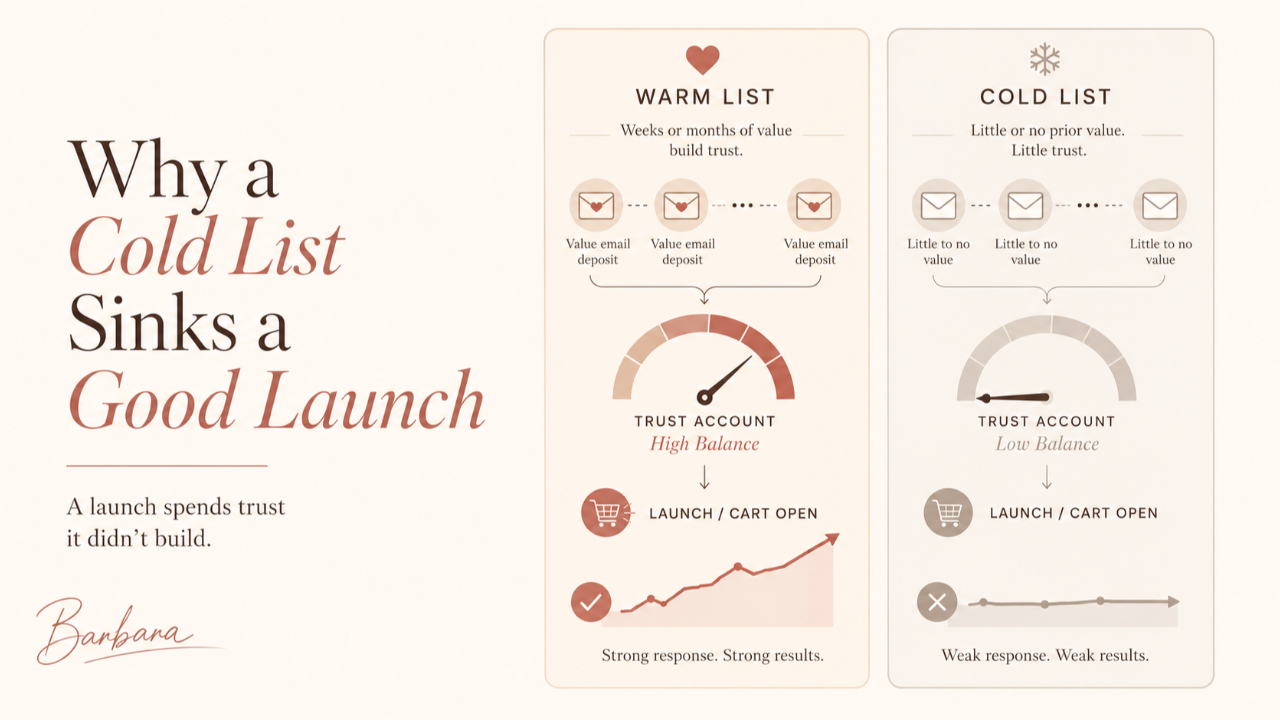
A cold list sinks a good launch because a launch spends trust it didn't build. The launch sequence is short, usually a week or two, and it can only convert warmth that already exists on the list. If subscribers haven't heard from you in months, never opened your emails, or never really knew you, a burst of launch emails can't manufacture the relationship in time. The offer can be excellent and the launch emails well-written, and it still falls flat, because the buying was supposed to be built in the weeks before the cart opened, not during. You can't warm a cold list in launch week; you warm it in the months before.
That's a hard thing to hear after a launch that didn't land, because it points away from the offer and the emails you just poured effort into. So let's walk through why it's true, and what to do about it.
The launch is a withdrawal, not a deposit
Picture your relationship with your list as an account. Every time you show up in the inbox with something genuinely useful, you make a deposit of trust. Over weeks and months, those deposits add up to a balance: people who know you, open your emails, and believe you're worth listening to.
A launch is a withdrawal from that account. When you open the cart and ask people to buy, you're spending the trust you banked. Launch to a warm list and there's a healthy balance to draw on, so the withdrawal goes through. Launch to a cold list and the account is empty, so the withdrawal bounces, no matter how good the offer or how well-crafted the emails.
This is the maxim at the heart of the launch layer: the launch spends the trust the runway built. The weeks of consistent, valuable contact before the launch are the runway, and they're where the trust gets banked. The launch itself doesn't build trust; it spends it. That's why How to Run a Course Launch That Doesn't Fizzle puts so much weight on what happens before the cart opens, and why a launch to an empty account is the most common way a good offer ends up looking like a failure. It's also the first thing to check when a launch underperforms, which is exactly where Why Did My Course Launch Fail? starts.
What a cold list actually is
"Cold" is easy to say and easy to miss in your own business, so here's what it actually looks like. A list is cold when one or more of these is true.
Subscribers haven't heard from you in a long time. If you went quiet for months and then reappeared to sell, the people on your list barely remember opting in, let alone why they trusted you.
Opens and clicks are low. When most of your list never opens your emails, they're not a warm audience; they're a number. The engagement, not the count, is what predicts buying.
They opted in for something unrelated to what you're launching. A subscriber who joined for a freebie on one topic isn't warm for an offer on a different one. They raised their hand for something else.
They never got a real welcome or any nurture. If people opted in and then heard nothing until the launch, the relationship never actually started. They're strangers who happen to be on a list.
One distinction matters most here: cold is not the same as small. A small, warm list often out-launches a big cold one, because a launch converts engaged people, not email addresses. This is where list size actively hides the problem. A big list looks like an asset sitting in your dashboard, but if it's cold, it behaves like a liability the moment you launch, because it sets an expectation the launch can't meet.
A week can't undo months of silence
The reason a launch can't rescue a cold list is simply timing. Launch sequences are compressed by design. You have a short runway of emails, a week or two, then the cart opens and the clock runs. That structure works beautifully when the trust is already there, because the launch only has to spend it. It fails when the trust isn't there, because building trust is slow and the launch is fast.
Trust doesn't form on a one-week timescale. It forms over the months of showing up consistently, being useful, and asking for nothing, so that by the time you do ask, you've earned the right to. A launch sequence has no time to do that job. It was never designed to. Expecting it to warm a cold list is like expecting one intense conversation to make up for months of not calling.
Worse, trying can actively backfire. When you send a sudden burst of sell-heavy emails to people who forgot they subscribed, a chunk of them don't just ignore it, they unsubscribe or mark it as spam. So not only does the launch fail to convert the cold list, it can damage your standing with email providers and shrink the list in the process. The mechanism of how warming actually works, and why it can't be rushed, is the whole subject of How Email Turns Subscribers Into Buyers.
Cold is usually a symptom of a lower layer
Here's the part that turns this from a scolding into a diagnosis. A cold list is often not the root problem itself. It's a symptom of something lower in the system, and that's where the real fix lives.
Trace it down. The list may be cold because the email layer never nurtured it, no welcome, no rhythm, no value between launches. That's an email-layer problem, covered in the email cornerstone. Or it may be cold because the lead magnet attracted the wrong people, folks who grabbed a freebie but were never going to care about the paid offer. Or the coldness may start even further down, at a niche so broad it pulled in a mismatched crowd who were never really your people to begin with.
So "warm the list" sometimes means "fix why it keeps going cold." If you nurture a list that was filled by a mismatched lead magnet, you're warming the wrong people. This is the framework's recurring lesson: the symptom is rarely the problem, and you fix the lowest broken layer first. A cold list is a symptom that often points below itself. If you're not sure how far down it goes, How to Diagnose Why Your Course Business Isn't Selling walks the layers in order.
Warm before you launch, not during
The fix is straightforward to state: build the warmth before the cart opens, not during. Here's what that looks like in practice.
Show up consistently in the inbox for weeks or months before the launch. A regular rhythm of useful emails is what rebuilds the habit of opening and the expectation of value, which is the whole practice of nurturing a list so it stays warm.
Deliver enough genuine value that opens and clicks recover. You want to see the list re-engage before you ask it to buy. Rising engagement is the sign the account is filling back up.
Re-engage or prune the truly dead subscribers, so you're launching to people who actually want to hear from you, not dragging along a mass of addresses that only hurt your deliverability and your read on the numbers.
Then, and only then, run the launch. The launch spends the trust; the weeks before are where you bank it.
And if a launch is bearing down on you and the list is honestly cold, the hard but usually correct move is to delay the launch and warm the list first. Launching into silence rarely produces sales, and it burns an offer you could have launched well later. A delayed launch to a warm list beats an on-time launch to a cold one almost every time. The full picture of building that runway is in How to Run a Course Launch That Doesn't Fizzle.
If the launch already flopped
If you're reading this after a launch that underperformed, resist the first conclusion most people reach. The instinct is to decide the offer was wrong, or the launch emails weren't persuasive enough, and to start rebuilding both. But if the list was cold, neither was necessarily the problem, and rebuilding them won't help.
Diagnose honestly instead. Ask one question first: were people actually engaged before the cart opened? Look at your open and click rates in the weeks leading up to the launch, not during it. If the list was quiet before you launched, the coldness is the likeliest culprit, and the fix is the list, not another offer rewrite or a flashier launch sequence.
This matters because rewriting the offer when the real problem was a cold list is wasted effort, and it leaves the actual cause in place for next time. The full launch-failure post-mortem, which walks the other possible causes too, is in Why Did My Course Launch Fail?, and the warming work itself is in How Email Turns Subscribers Into Buyers.
Where this sits in the system
In the seven layers, the launch is the sixth layer and the email list is the third. The launch rests on the list, among the layers below it, and it can only convert the warmth the list already holds. That dependency is the whole story of this article.
A cold list is precisely where the launch layer and the email layer meet. It's why so many launch failures turn out, on inspection, to be email-layer failures in disguise: the launch gets blamed because that's where the disappointment showed up, but the cause was a list that was never warmed. The pain surfaces at the launch; the problem lives one layer down. If you want the map of how the layers connect, How to Diagnose Why Your Course Business Isn't Selling lays out all seven, and Why Is My Online Course Not Selling? is the short way in.
The short version
A launch spends trust it didn't build, so a cold list sinks even a good one. You bank trust in the months before the cart opens, through consistent, valuable contact, and the launch simply spends it. A week of launch emails can't warm a list that went cold over months, and trying can cost you subscribers. Often the coldness is itself a symptom of a lower layer, the email nurture, the lead magnet, or the niche, so warming the list sometimes means fixing why it keeps going cold. Warm before you launch, not during, and if the list isn't ready, warm it first even if that means waiting.
If your launch fell flat and you suspect the list, the free Course Business Diagnostic shows whether the email layer, or something beneath it, is the real problem.
Take the free Course Business Diagnostic
FAQ
How long does it take to warm up an email list? Longer than a launch sequence and shorter than you might fear, but there's no fixed number, because it depends on how cold the list is and how consistently you show up. The honest signal isn't a date on the calendar; it's engagement recovering, opens and clicks climbing back as people rebuild the habit of hearing from you. Plan in terms of weeks to months of steady, valuable contact, and let the re-engagement, not a countdown, tell you when the list is ready.
Should I delay my launch if my list is cold? Usually yes. Launching into a cold list tends to produce weak sales and burns an offer you could have launched well later, so delaying to warm the list first is often the higher-return choice even though it feels like losing time. The exception is rare and situational, but as a rule, a launch that lands a month later against a warm list beats one that flops on schedule against a cold one. Protect the offer by launching it when the list can actually receive it.
Can I re-engage a cold list, or should I start over? You can usually re-engage a meaningful portion of a cold list, and that's almost always worth trying before writing it off. Show up consistently with genuine value, and a share of quiet subscribers will come back to life. The ones who never respond can be pruned, which actually helps, since a leaner engaged list serves you better than a bloated unresponsive one. You rarely need to start over completely; you need to revive the salvageable part and let go of the truly dead weight.
How do I know if my list is warm enough to launch? Look at engagement in the weeks before you plan to open the cart, not at list size. If a healthy share of subscribers are opening and clicking, replying, and generally acting like people who want to hear from you, the list is warm enough to spend that trust on a launch. If most of the list is silent, it isn't ready yet, regardless of how big it is. Engagement before the launch is the single best predictor of buying during it.
Is a small warm list better than a big cold one? For a launch, almost always yes. A launch converts engaged people, not email addresses, so a small list of subscribers who know you and open your emails will typically out-sell a large list that ignores you. The big cold list looks better in a dashboard, but it sets an expectation the launch can't meet and can even hurt your deliverability. Warmth beats size when it's time to sell, which is why building engagement matters more than chasing subscriber count.