How to Nurture an Email List That Stays Warm
Aug 01, 2026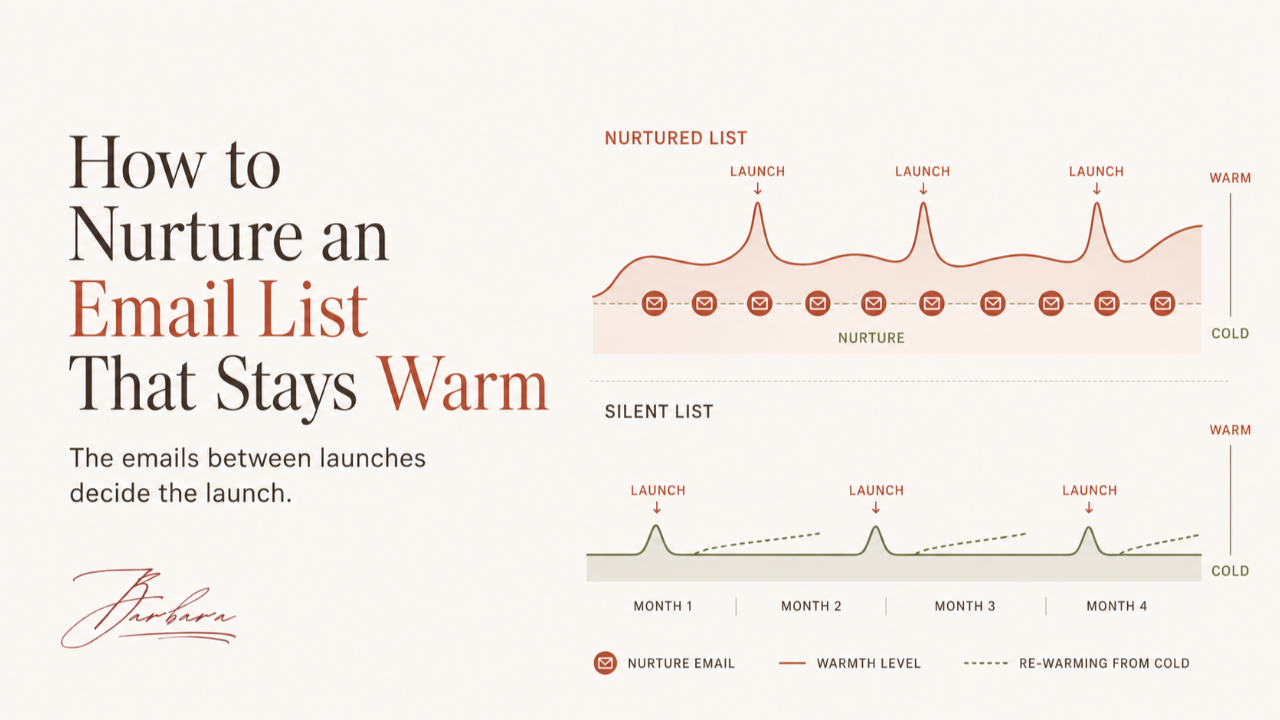
Nurturing an email list means sending genuinely useful, connection-building emails on a consistent rhythm between your offers, so that when you do ask for a sale, it lands on people who already trust you. A list stays warm when most of what it receives gives value rather than asks for money, when it hears from you predictably rather than only at launch time, and when the emails are worth opening on their own. The practical rhythm is simple: show up consistently, give far more than you ask, and treat every email as either building trust or spending it. This ongoing warming is the runway, and it is what makes launches convert.
If you already have a welcome sequence in place, this is what comes after it, the long relationship that keeps a list warm for good. Here's how to run it without either going silent or turning into someone who only shows up to sell.
A list you ignore goes cold
Warmth is not a permanent state. A list warmed once and then left alone slowly cools, the same way any relationship fades when the contact stops. So nurturing isn't a one-time task you complete. It's the maintenance that keeps a list warm over time.
Here's how it goes wrong. You set up a welcome sequence, it warms new subscribers beautifully in their first week, and then they roll off into silence. Weeks pass with no contact. By the time you email again, the warmth the welcome sequence built has drained away, and you're emailing people who barely remember signing up. When you eventually launch to that list, it behaves like a room full of strangers, because that's effectively what it has become.
This is the runway that every launch spends, and it's the whole subject of how email turns subscribers into buyers. Nurturing is how you keep that runway built, so it's there when you need it.
The runway isn't a phase, it's a habit
Most people think of the runway as a pre-launch push: a few weeks of warming emails right before a sale, then back to quiet. That version half-works at best, because a list warmed only in the weeks before a launch is being crammed, not nurtured. You can feel the difference on the receiving end, a burst of sudden attention right before an ask reads as exactly what it is.
The real runway is continuous. It's the relationship that runs all the time, in the long stretches between launches, not just in the sprint before one. A list nurtured continuously is genuinely warm whenever you need it, because the trust was built steadily rather than manufactured in a rush. When you launch, you're spending trust that's already there, not scrambling to build it in the final two weeks.
So reframe the runway as a habit, not a phase. The work of warming isn't something you switch on before a launch and off afterward. It's the ongoing rhythm of showing up, and that rhythm is what separates a list that reliably buys from one that has to be re-warmed from cold every time you want to sell something.
What a nurture email is
The question everyone gets stuck on is "what do I actually send?" Here are the kinds of emails that keep a list warm, each one building trust or connection rather than asking for anything.
Useful teaching. A quick tip, a small how-to, a reframe that helps the reader with the problem your work is about. Short and genuinely useful beats long and comprehensive.
A story. A personal or client story that teaches or connects. Stories are also how you handle objections without being salesy, a story about someone who had a doubt and what happened dissolves that doubt far better than an argument.
A point of view. Your honest take on something in your space. Sharing what you actually believe, even when it's a little contrarian, builds a distinct voice and the kind of trust that comes from a real person rather than a faceless sender.
A small win. Help them get a little result right there in the email. A first win delivered by email warms a subscriber the same way a first win in a course does, by proving you can help before you ask for anything.
Connection. A behind-the-scenes look, a genuine question, an invitation to reply. These turn a broadcast into a relationship, and a subscriber who has replied to you once is far warmer than one who never has.
The test for every one of these is the same: would this email be worth opening even if you never sold anything? If yes, it's building warmth. If it's filler, it's spending attention without depositing anything. And the emails resonate most when they use your audience's own language, the exact words real buyers use about their problem, which is what voice-of-customer research gives you.
Show up predictably
When it comes to cadence, consistency matters more than frequency. A predictable rhythm is what trains the habit of opening your emails, both for the subscriber, who comes to expect and recognize you, and for you, who needs a sustainable routine more than a heroic one.
A good email every week beats a brilliant one every quarter. Weekly is a common sweet spot, but the specific number matters less than the reliability. Sporadic bursts followed by long silences are the worst pattern, because each silence lets the relationship cool and each reappearance has to spend energy re-establishing it. Steady, predictable contact keeps the line warm.
One thing worth saying plainly: under-emailing is the far more common mistake than over-emailing. Many creators email too little out of a fear of bothering people, and lose warmth to silence as a result. As long as the emails carry real value, showing up more often usually helps rather than hurts. The subscribers who'd be annoyed by a useful weekly email were rarely going to buy anyway.
Mostly give, occasionally ask
The balance that keeps a list warm is simple to state: mostly give, occasionally ask. A useful guide is something like two to three value emails for every one that asks for a sale, though the right ratio varies with your list, your niche, and how often you send.
The principle underneath the ratio is that every email either deposits trust or withdraws it. Value emails deposit; asks withdraw. Keep depositing far more than you withdraw, and the account stays healthy. A list that only ever hears from you when you want money learns to brace when your name appears, not to buy, because you've trained it to associate you with being sold to.
But the flip side matters just as much: never asking at all is also a failure. Nurturing is not a vow of never selling. It's earning the right to sell by giving first. A list you nurture beautifully but never make an offer to produces warmth and no revenue, which helps no one, least of all the subscribers who'd have benefited from what you sell. The occasional, well-earned ask is a healthy part of the rhythm, not a betrayal of it. And when you do ask, remember that the email's job is to earn the click, not to close the sale in the inbox.
The gap between launches is where warmth is won
Here's the specific place most warmth is lost: the dead zone between launches. The common pattern is to nurture a little in the weeks before a launch, sell hard during it, and then go quiet until the next one. That quiet stretch is exactly where the damage happens.
A list nurtured through the gap arrives at the next launch already warm, and that launch is easier and converts better. A list ignored through the gap has to be re-warmed from cold every single time, which is exhausting to do, easy to get wrong, and often fails outright. You end up sprinting to rebuild in a few weeks what steady contact would have maintained effortlessly, and a launch to a list you've just scrambled to re-warm frequently falls flat. That failure looks like a launch problem, but it started in the silence between launches. It's the trap behind why a cold list sinks a good launch, and it's why a launch that doesn't fizzle is built on the weeks and months before it, not the launch emails themselves.
So the gap between launches isn't downtime. It's where the next launch is quietly won or lost.
Making it sustainable
The real barrier to nurturing well is never a shortage of ideas. It's sustainability. Here's how to build a habit you'll actually keep.
- Pick a cadence you can hold for a year. Choose a rhythm you can sustain through busy weeks, not an ambitious schedule you'll abandon in a month. A modest, reliable cadence beats a heroic one that collapses.
- Keep a running list of ideas. Jot down questions subscribers ask, tips, and stories as they occur to you, so you never sit down to a blank page. Most nurture struggle is really blank-page struggle, and a running idea list solves it.
- Batch when you can. Writing several emails in one sitting helps, but don't let batching become a reason to skip weeks. Consistency still comes first.
- Reuse your best thinking. A good idea can be an email now, a social post later, and eventually a lesson. You don't need endlessly new material, you need to use your best material well.
- Watch engagement, not size. Opens, replies, and clicks are the real signal of warmth. A growing list with falling engagement is cooling; a steady list with rising engagement is warming. Track the warmth, not the vanity number.
- Keep the ratio honest over time. It's easy to drift toward more asking as launches pile up. Periodically check that you're still giving far more than you ask.
Design the rhythm around what you'll genuinely maintain, because a nurture habit only works if it survives contact with a busy month.
Common nurture mistakes
- Only emailing to sell. A list that hears from you exclusively at launch time learns to brace, not buy.
- Going silent between launches. The gap is where warmth is lost. Silence followed by a pitch resets the relationship to cold every time.
- An unpredictable cadence. Sporadic bursts break the opening habit. Reliable beats frequent-but-random.
- Sending emails that aren't worth opening. "Just checking in" with no value spends attention without depositing trust. Every email should earn its open.
- Inverting the ratio. Mostly asking and rarely giving drains trust faster than you build it.
- Never asking at all. Endless nurturing with no offer produces warmth and no revenue. The earned ask is part of the rhythm.
- Chasing list size over engagement. A big cold list is worth less than a small warm one. Watch warmth, not headcount.
- Being safe and boring. No point of view means no reason to keep opening. A real voice is what keeps a list engaged.
Where nurturing sits
Nurturing is the ongoing work of the email layer, the maintenance of the runway. It picks up where the welcome sequence leaves off, keeps the list warm for the offer and the launch above it, and is the quiet difference between a launch that converts and one that flops. It depends on the lead magnet below to have brought in the right people, and it pays off in the launch above, where the warmth it built gets spent.
This is why a launch failure or a quiet offer so often traces back to nurturing that never happened. The pain shows up at the launch; the cause is a list that was warmed once and then neglected. If you want the whole system, How to Diagnose Why Your Course Business Isn't Selling walks all seven layers in order, and Why Is My Online Course Not Selling? is the short way in.
The short version
Nurturing keeps a warmed list warm through consistent, value-first emails sent between your offers. Treat the runway as an ongoing habit, not a pre-launch sprint. Send things worth opening on their own, teaching, stories, your point of view, small wins, and real connection, on a rhythm you can actually sustain. Mostly give, occasionally ask, and remember that both never-selling and only-selling are failures. Do this steadily, and your list is warm whenever you need it.
If your list has gone quiet, or a launch to it fell flat, the free Course Business Diagnostic helps find whether the leak is your list, your offer, or a layer further down.
Take the free Course Business Diagnostic
FAQ
How often should I email my list to keep it warm? Often enough to stay familiar and consistently enough to be predictable, which for most people means at least weekly. The exact number matters less than holding a rhythm you can sustain, because a reliable cadence trains the habit of opening while unpredictable gaps let the relationship cool. Choose a frequency you can genuinely maintain through busy stretches and keep it, since a modest steady rhythm beats an ambitious one you abandon.
What do I send when I have nothing to sell? Value: a quick tip, a helpful story, your take on something in your space, a small win the reader can get right in the email. The test is whether the email would be worth opening even if you never sold anything. Most of what you send should be exactly this, because it's what builds the trust that makes your occasional offers land. Having nothing to sell is the normal state of nurturing, not a problem to solve.
Won't emailing too often annoy people and cause unsubscribes? Some unsubscribes are normal and even healthy, since people who don't want your emails leaving makes your list warmer, not weaker. As long as the emails carry genuine value, emailing consistently helps far more than it hurts, and under-emailing out of fear is the more common and more costly mistake. Focus on making each email worth opening rather than on sending as little as possible, and the people who stay will be the ones who buy.
How do I nurture without spending all my time on it? Keep a running list of ideas so you never face a blank page, batch several emails when you have momentum, and reuse your best thinking across emails, posts, and eventually lessons. The goal is a sustainable rhythm, not a heroic one, so pick a cadence you can hold through a busy month rather than an ambitious schedule you'll drop. Nurturing done at a modest, steady pace for a year beats an intense burst that burns out in three weeks.
My list has gone cold, can I re-warm it? Often yes, though it takes patience. Start showing up again consistently with genuinely valuable emails, and give it time before you ask for anything, since you're rebuilding trust that faded. Expect some people to have forgotten you, and some to unsubscribe, both are normal and fine. A re-warming stretch of steady, value-first emails can bring a cold list back to life, and the lesson for next time is to keep nurturing through the gaps so it doesn't go cold again.