How to Build a Value Ladder for Your Course Business
Aug 01, 2026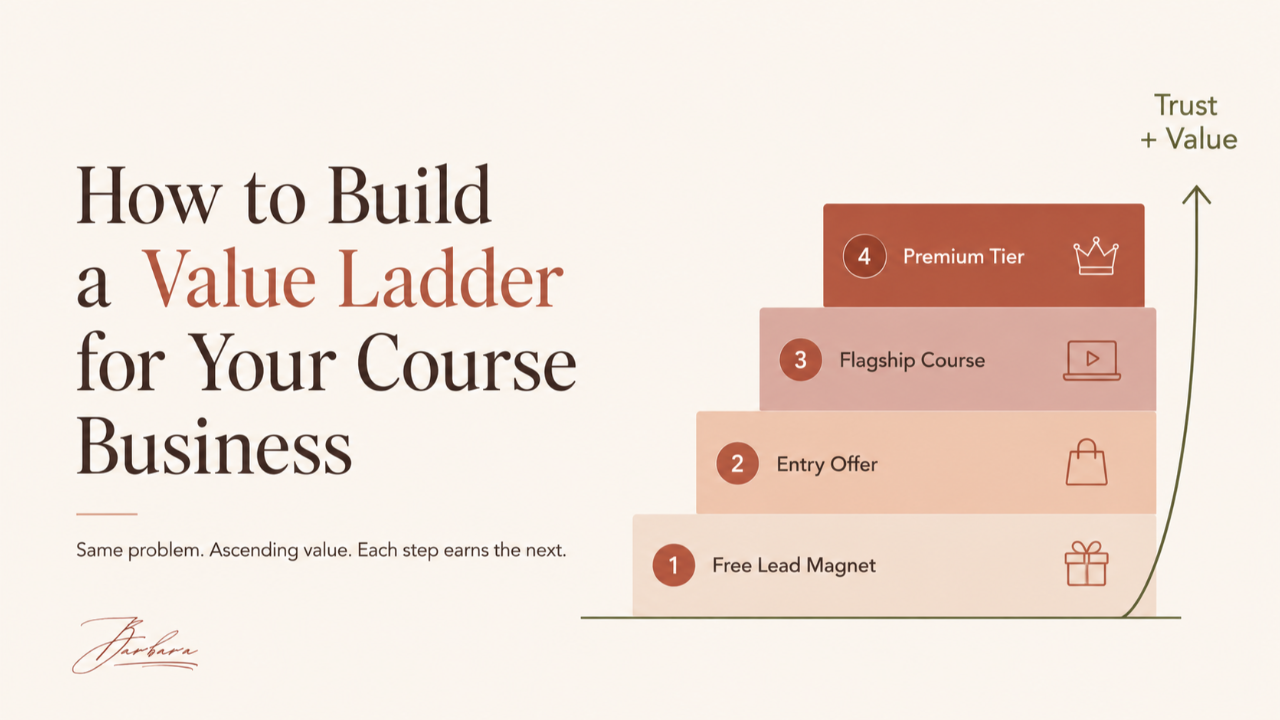
A value ladder is the sequence of offers a buyer can climb, from a free first result up through progressively bigger, higher-priced solutions to the same core problem. It works because trust and value rise together: each step delivers a real result, which earns the belief that makes the next step up a reasonable yes. You build one by anchoring every rung to the same audience and problem, making sure each step delivers a genuine outcome on its own, and designing each to lead naturally into the next, starting from your free lead magnet and ascending through an entry offer, a flagship, and a premium tier as far as it makes sense for your business.
If you have a single offer and nothing before or after it, you're leaving both money and trust on the table, and this is the structure that fixes it.
One offer leaves money and trust on the table
A single offer forces every potential buyer through one door at one price. The people who aren't ready for that level of commitment have no smaller way in, so you lose them. And the people who finish and want more have nowhere to go, so you lose them too, at the exact moment they trust you most. One offer serves only the slice of your audience ready for precisely that thing, right now.
A value ladder meets people where they are instead. Someone who isn't ready to buy your main course can start with something free or small, get a real result, and grow into a bigger yes over time. Someone who just finished your flagship and wants to go deeper has a next step waiting. The ladder lets the relationship deepen rather than ending at a single transaction.
This isn't a separate discipline bolted onto your business. It's an extension of the offer layer, the same design thinking from how to build an offer people can't ignore, applied across several offers that lead into each other instead of one that stands alone.
A path, not a catalog
Here's the distinction that trips people up: a value ladder is not the same as having several products.
You can have five courses and no value ladder at all, if they're five unrelated things aimed at different people solving different problems. That's a catalog, and a catalog doesn't ladder, because nothing leads anywhere. A buyer of one has no particular reason to want another. There's no path, just a shelf.
A value ladder has four properties that a catalog lacks. Every rung serves the same audience. Every rung solves the same core problem, just a bigger slice of it. The rungs ascend in value and price. And each rung leads naturally to the next. That last property is what makes it a ladder instead of a pile: someone who climbs one step is, by design, set up to want the step above it. Same person, same problem, more depth, higher price, each step opening onto the next.
So the test of a value ladder isn't how many offers you have. It's whether they form a path a single buyer would naturally walk, from their first small result to the fullest version of the transformation.
Each rung earns the next
Why does ascension work at all? Because trust and value climb together, and each rung earns the one above it.
Every time someone gets a real result from one of your offers, their belief that you can deliver goes up. That earned belief is what lowers the risk of the next, bigger step. A person who paid a little, got a genuine outcome, and thought "that worked" approaches your flagship already believing it will work too. The proof is their own experience. So each rung, by delivering, pre-sells the rung above it.
This is the perceived-likelihood lever from the offer framework, operating across offers instead of inside one. Within a single offer, testimonials and guarantees raise the belief that the outcome is achievable. Across a ladder, the buyer's own results do the same job, even more powerfully, because nothing convinces someone they can get a result like having already gotten a smaller one from you.
That's also why the lower rungs matter so much, and why a fast first win on the free and cheap steps is what makes the expensive steps believable. The ladder isn't a pricing trick that trains people to spend more. It's a trust-building sequence where each delivered result earns the right to offer the next thing.
The rungs, from free to premium
A typical course ladder has four rungs, each solving the same problem at greater depth, touch, and price.
The free rung: your lead magnet. The bottom step is a quick, free win that earns the opt-in and proves you can help. It solves one small piece of the core problem, and it's the whole subject of what makes a lead magnet actually convert. The free rung is where the relationship starts.
The entry offer. A low-priced, low-risk first purchase, a small course, a workshop, a template kit, that converts a subscriber into a buyer. This step crosses one of the most important lines in the whole ladder: the line between someone who has only ever gotten free things from you and someone who has paid. A buyer is a fundamentally different relationship than a subscriber, and the entry offer is what turns one into the other.
The flagship. Your core offer, the fullest self-guided solution to the core problem, where most of your value and most of your revenue live. This is usually the anchor of the whole ladder, the thing the other rungs lead toward or extend from.
The premium tier. A higher-touch, higher-priced step for the people who want more access, more speed, or more depth, group coaching, done-with-you work, a mastermind, or one-to-one. Not everyone climbs this far, but the few who do are often worth a large share of your revenue, and they're the buyers who already trust you most.
One important thing: you do not need all four rungs at once. Most creators start with just a lead magnet and a flagship, then add an entry offer below and a premium tier above as they grow. The ladder can even start before the flagship fully exists. Build the rungs over time, in the order that serves your buyers.
Each step priced to its value and its trust
Pricing across a ladder follows one principle: each rung is priced to the value it delivers and the trust the rung below already built. The jumps between steps should feel proportional to the jump in value and depth, not arbitrary. A buyer who climbs from a small workshop to a full flagship should feel the price rise because the thing genuinely got bigger, not because a number went up for no reason they can see.
A ladder also makes each individual price easier to justify, because buyers arrive at each rung already believing. Someone considering your flagship cold has to be sold from scratch. Someone considering it right after a great result from your entry offer is most of the way to yes before they even see the price. The lower rungs do the persuading, so the higher rungs can simply be worth their price.
This is exactly where the idea of pricing an offer relative to your other offers comes in, which is one of the steps in how to price your online course. A price isn't set in isolation; it's set in the context of the rung below it and the rung above it.
Email is how buyers climb
The ladder is the structure. Email is the engine that actually moves people up it.
Rungs don't climb themselves. A subscriber doesn't become a buyer, and a buyer doesn't ascend to the next offer, unless something invites them to, at the right moment. That something is almost always email. A nurture sequence turns free subscribers into first-time buyers. A post-purchase sequence invites happy buyers up to the next rung, ideally right after they've gotten a result and their trust in you is at its peak.
That timing is the whole game. The best moment to invite someone up the ladder is the moment they just succeeded on the current rung, because that's when belief is highest and the next step feels like a natural continuation rather than a new decision. Building those sequences, and the trust that makes them work, is the subject of how email turns subscribers into buyers. A ladder without email is just a price list nobody is being walked up.
Building your ladder
Here's how to build one, and notice it starts from the problem, not from a list of products you'd like to sell.
- Start from one core problem and audience. The entire ladder solves the same problem for the same person. If a rung serves a different audience or a different problem, it belongs on a different ladder, or nowhere.
- Map the journey. Sketch the path: what's the first free win, the first small paid win, the full transformation, and the premium version of it. You're mapping a single person's journey from first contact to deepest commitment.
- Anchor it with the flagship. If you don't have your core offer yet, build it first, because it's the anchor the other rungs lead toward. If you do have it, identify the rung directly adjacent, usually an entry offer just below, or the lead magnet that feeds it, and build that next.
- Make every rung stand alone. Each step has to deliver a real, complete result by itself. A rung that doesn't stand on its own breaks the trust chain, because it fails to earn the step above it.
- Connect the rungs with email. Wire each step to the next with a nurture or post-purchase sequence and a natural next-step invitation, so climbing is easy and obvious.
- Add rungs over time. Don't build all four before validating any. One rung that genuinely converts is worth more than four that don't, so prove each step works before you build the next.
The discipline here is resisting the urge to architect the whole elaborate ladder up front. A lead magnet and a flagship that convert is already a working ladder. Everything else is an addition you earn.
Common value ladder mistakes
- Building a catalog and calling it a ladder. Unrelated products for different people don't lead anywhere. A ladder is one audience, one problem, ascending depth.
- Jumping straight to a premium offer. Asking for a big, high-ticket yes with no lower rungs means asking for trust you haven't built yet. Give people smaller steps first.
- Skipping the entry offer. With no low-priced first purchase, subscribers never cross the line into buyers, and the biggest relationship jump never happens.
- Pricing rungs arbitrarily. Jumps that don't match the jump in value feel random and erode trust. Price each step to its value and the trust beneath it.
- Building every rung before validating one. An elaborate four-rung ladder where nothing converts is four problems, not one. Prove a rung, then add.
- Making a rung that doesn't deliver on its own. If a step doesn't produce a real result, it can't earn the step above it, and the chain breaks there.
- Forgetting email. A ladder with no ascension sequences is a static price list. Email is what carries people up.
Where the ladder sits in the system
The value ladder isn't one of the seven layers. It's how the offer layer extends into a full customer journey. It's anchored to the niche, since every rung solves the same core problem, built from offers, fed by the lead magnet at the bottom, and climbed by way of email. It's what turns a one-time sale into an ongoing relationship.
It's also the groundwork for any ascension offer, including a premium tier or a higher-level report or program that sits above your flagship for the buyers who want more. If you're thinking about what comes after your core course, you're thinking about your ladder. Before you build upward, though, make sure the offer at the center of it actually converts, because a ladder built around a weak flagship just spreads the weakness across more rungs. How to Diagnose Why Your Course Business Isn't Selling walks the whole system, and Why Is My Online Course Not Selling? is the short way in.
The short version
A value ladder is a path buyers climb, the same problem solved at ascending depth and price, where each delivered result earns the next step up. Build it on one audience and one problem, make every rung stand alone, start with just a lead magnet and a flagship, and add an entry offer below and a premium tier above over time. Connect the rungs with email, which is what actually carries people up. Done well, it turns a single sale into a relationship that keeps deepening.
Before you add rungs to your ladder, make sure the offer at its center actually converts. The free Course Business Diagnostic finds the layer that's holding your core offer back.
Take the free Course Business Diagnostic
FAQ
How many offers do I need for a value ladder? You can start with two: a free lead magnet and a paid flagship is already a working ladder. You don't need four polished rungs to begin, and trying to build them all at once usually means none of them gets the attention it needs. Start with the two that matter most, prove they convert, and add an entry offer or a premium tier later as the relationship with your audience deepens. A small ladder that works beats a tall one that doesn't.
What comes first, the lead magnet or the flagship? Usually the flagship, because it's the anchor the rest of the ladder is built around, and because a lead magnet only works when it points toward a paid offer that exists. Design your core offer first, then build the lead magnet as the free first step that leads toward it. If you already have a lead magnet but no flagship, your priority is building the thing it should lead to, since a free rung with nothing above it just collects emails that have nowhere to go.
How big should the price jumps between rungs be? Big enough to match a real jump in value and depth, and no bigger. The rise in price should feel earned by the rise in what the buyer gets, so a step from a small workshop to a full flagship naturally costs more because it delivers much more. There's no fixed ratio, and any rule of thumb you see quoted varies widely by niche and audience. Focus on making each jump feel proportional to the added value rather than hitting a specific multiple.
Do I need a premium or high-ticket offer? No, not to have a functioning ladder, and not at the start. Plenty of course businesses run well on a lead magnet, an entry offer, and a flagship, with no premium tier at all. A high-touch top rung is worth adding once you have buyers who've climbed the lower steps and clearly want more access or depth, because they'll tell you the demand is there. Add it when the demand exists, not because a ladder is "supposed to" have one.
What's the difference between a value ladder and an upsell? A value ladder is the overall structure of ascending offers that solve the same problem at greater depth; an upsell is one tactical moment, offering a higher or additional item at the point of purchase. Upsells can be part of how people move up a ladder, but they're a mechanic, not the whole map. The ladder is the strategic journey from first free win to premium tier; upsells and post-purchase invitations are some of the specific ways buyers take the next step.