How to Price Your Online Course
Jul 31, 2026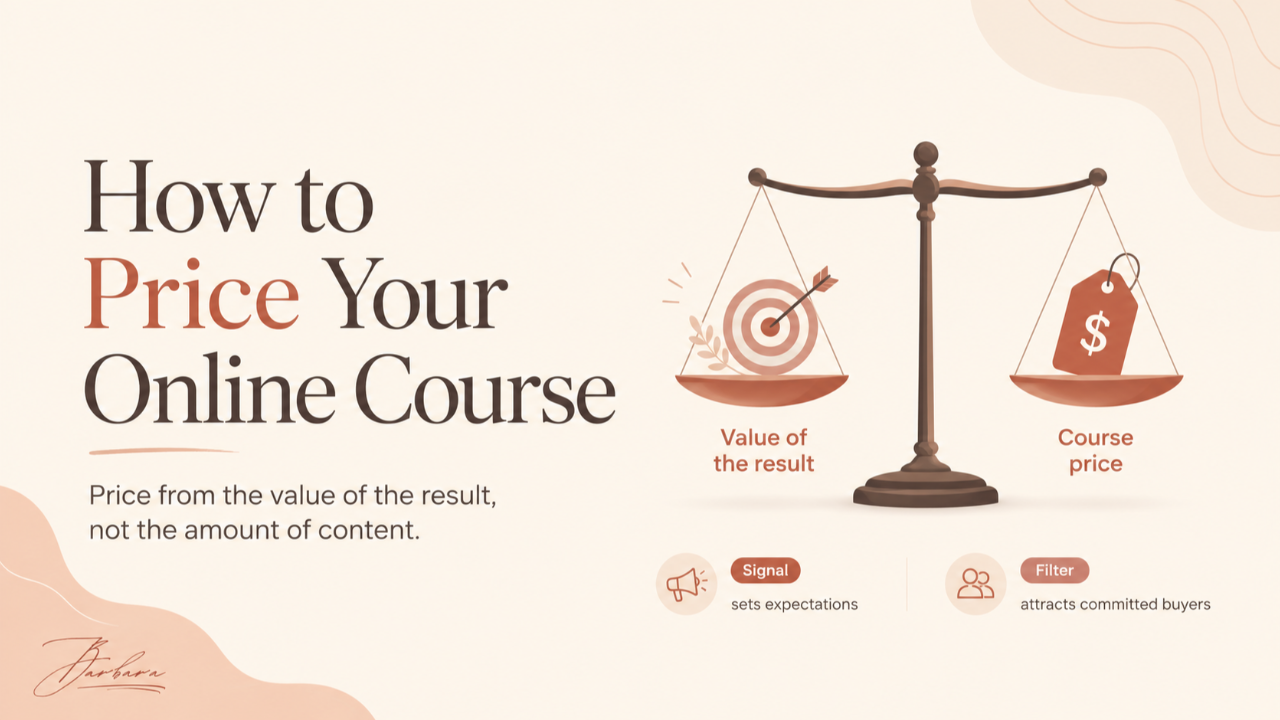
You price an online course based on the value it delivers to the buyer, not on the number of videos, your production costs, or what feels comfortable to charge. A price is a signal and a filter as much as a number: it tells buyers what to expect and decides who shows up. The far more common mistake is pricing too low, which quietly signals low value, attracts less committed buyers, and forces exhausting volume. The right price is the one your offer's value can support and your ideal buyer will pay, and if a price feels hard to say out loud, the usual fix is to strengthen the offer until it's justified, not to cut the number.
Pricing gets treated as a last-minute guess more than almost any other decision in a course business, which is strange, because few decisions shape the outcome more. So let's slow down and do it properly.
Price is a decision, not a guess
Here's how pricing usually happens: the course is nearly built, launch is looming, and the creator picks a number that feels okay, or copies whatever a competitor charges, or lands on whatever makes them least nervous to say out loud. The price is an afterthought, chosen by feeling rather than reasoning.
But price isn't a cosmetic detail on top of the offer. It shapes who buys, how much they value what they get, and whether the business math works at all. Set it wrong and you can undermine a genuinely good course, either by scaring off the right buyers or, far more often, by signaling that the course is worth less than it is.
Price lives inside the offer layer of your business, the fourth of the seven layers, which sits beneath the sales page and the launch. That location matters: a pricing mistake is an offer-layer mistake, and it ripples up into everything built on top. Getting it right is part of building an offer people actually want, which is the job of How to Build an Offer People Can't Ignore.
What the price should actually be based on
The core mistake in pricing is anchoring to the wrong thing. Three wrong anchors come up again and again, and one right one.
Not the amount of content. The number of modules or videos is not value. A forty-video course that doesn't get anyone a result is worth less than a three-video course that reliably solves a real problem. Pricing by content volume pushes you to stuff the course with more material to "justify" the price, which usually makes it worse. Buyers aren't paying for hours of video. They're paying for an outcome.
Not your cost to produce it. What it cost you in time, tools, or effort is invisible to the buyer and irrelevant to them. Cost-plus pricing makes sense for manufacturing widgets; it makes no sense for a transformation.
Not what feels comfortable to charge. Comfort is about your fear, not the buyer's value. The number that feels safe to say out loud is almost always lower than the number the outcome is worth, because the discomfort you feel is impostor nerves, not market feedback.
Yes, the value of the outcome to the buyer. The right anchor is what solving this problem is actually worth to the person buying. A course that helps someone land clients worth thousands, or save months of wasted effort, or finally fix something that's been costing them, is priced against that value, not against your content or costs. This is the offer-is-the-skeleton principle applied to price: the price expresses the strength of the outcome, and the copy just communicates it. To price this way, you have to understand how your buyer describes the outcome and what it's worth to them, which is exactly what voice-of-customer research gives you.
Your price tells buyers what to expect
Price does something before anyone has watched a single lesson: it sets expectations. It's a signal, and buyers read it whether you intend them to or not.
A very low price on a serious problem signals low value. This is the part that surprises people. When someone has a painful, expensive problem and finds a course promising to solve it for almost nothing, the low price doesn't read as a bargain. It reads as a red flag, whispering that the solution probably isn't serious, because serious solutions to serious problems aren't usually priced like an impulse buy. So a too-low price can actively suppress sales rather than boost them.
A confident price does the opposite. When the price matches the seriousness of the problem, it tells the buyer you believe the course delivers, and that belief is contagious. This is why raising a price sometimes increases conversions: the higher number aligns the price with the weight of the problem, and the offer suddenly reads as credible. None of this means higher is always better. It means the price should match the value and the seriousness of the problem, and that matching is a signal buyers are constantly reading.
Your price decides who shows up
Price doesn't just signal. It selects. Whatever you charge acts as a filter on who becomes your buyer, and the two ends of the price range attract very different people.
Low prices attract price-sensitive, less committed buyers. When something costs almost nothing, it's easy to buy on a whim and just as easy to abandon. Cheap-course buyers refund more often, finish less often, and paradoxically generate more support work, because people who didn't invest much don't feel much commitment to following through. You end up with more customers, more questions, more refunds, and more exhaustion, for less money.
Higher prices attract committed buyers. Someone who pays a real price has made a real decision, and they tend to show up, do the work, and get the result. That matters far beyond the individual sale, because the buyers who finish and succeed are the ones who give you genuine testimonials and referrals, which feed every layer of the system. Committed buyers don't just pay more. They become your proof. So the price you set quietly chooses whether you'll serve a large crowd of half-committed refund risks or a smaller group who actually get results.
Why so many course creators underprice
The most common pricing mistake by a wide margin is charging too little, and it's worth understanding why, because the causes are mostly internal rather than strategic. This is a big enough trap, and a costly enough one, that it has its own deep dive: Why Course Creators Underprice covers the fear and mindset behind it, and how to work through it.
Underpricing usually comes from fear. The impostor feeling of "who am I to charge that," the fear of hearing no, the worry that a higher price will make people angry. Setting a low price feels safe, because it lowers the stakes of the ask. It also comes from copying other beginners, who inherited everyone else's fear-based pricing, and from confusing cheap with accessible. A price so low it signals low value and attracts uncommitted buyers doesn't actually serve those buyers well; it sells them something they're statistically likely to abandon.
The costs stack up. Underpricing signals low value, attracts the wrong buyers, and forces you into punishing volume, needing ten sales to make what three should have. And it starves the business of margin it will need later. A too-low price depresses your earnings per subscriber, and low earnings per subscriber can put paid traffic permanently out of reach, because you can't afford to acquire a customer who's barely worth anything. Underpricing doesn't just cost you on this sale. It can quietly cap how far the whole business can grow.
A practical way to set the price
There's no clean formula for pricing a course, because value isn't a calculation. But there is a sound reasoning process, and it beats guessing.
- Start from the outcome's value. Ask what solving this problem is genuinely worth to your buyer, in money, time, stress, or opportunity. That's the ceiling you're pricing against, and it's usually much higher than the number you'd reach by instinct.
- Sanity-check against comparable offers. Look at what similar transformations sell for in your space, as a reference point for what the market bears, not as a floor to copy. You're calibrating, not conforming.
- Position it against your other offers. If you have more than one offer, price this one so the ladder makes sense, an entry offer, a flagship, a premium tier, each priced to reflect its depth.
- Pick a confident price the value can support. Choose a number that reflects the outcome, not your nerves, and then make the sales page do the work of justifying it. A strong price plus a page that communicates the value is a very different thing from a strong price alone.
- Treat it as adjustable. Price isn't permanent. You can start where the value supports it today and raise it as proof, results, and demand accumulate. Many creators raise prices repeatedly over a course's life.
One rule ties this together: if a price feels indefensible, that's a signal to strengthen the offer, not to lower the number. The reflex to cut the price when it feels too high is almost always the wrong move. Build the offer up until the price feels earned, and you've fixed the real problem instead of masking it. That's the work of the offer layer.
Is it really the price, or the offer?
When sales are slow, price is one of the first things people blame, and usually one of the wrong ones. So it's worth diagnosing honestly before you touch the number.
Ask this: are warm people who clearly understand the value still declining purely because of the price, or do they not perceive enough value yet? Those are completely different problems. If people don't grasp what the course will do for them, that's not a price problem, it's a communication problem living on the sales page or in how the offer is framed. If people grasp the value fully and the offer still isn't compelling at any reasonable price, that's an offer problem. Genuine "the price is simply too high for the value" is rarer than it feels, because most price resistance is really unclear or insufficient value wearing a price-tag costume.
This is the same lesson that runs through the whole framework: the symptom is rarely the problem. Price is often the symptom; unclear value or a weak offer is often the cause. The specific fork between an offer problem and a page problem is walked in Is It a Sales Page Problem or an Offer Problem?, and it applies directly to pricing: before you change the number, find out whether the number was ever really the issue.
Common course pricing mistakes
- Pricing by content volume or cost. Neither is value. Stuffing in more videos to justify a price usually makes the course worse.
- Copying a competitor's number. You can't see their value, their audience, or their context. Their price is not your price.
- Pricing from fear. The comfortable number protects your nerves and undercharges for the outcome. It's the single most common pricing error, and it's enough of a trap that Why Course Creators Underprice is devoted entirely to it.
- Discounting the moment sales are slow. Cutting the price signals lower value and rarely fixes why people didn't want it. Strengthen the offer or clarify the value instead.
- Never revisiting the price. A price set nervously at launch often stays there for years, long after proof and demand justify raising it.
- Faking the discount. A "was $500, now $200" anchor that was never really $500 is a fake, and like fake urgency it costs you trust. If you discount, make the original price real.
Where price sits in the system
Price lives inside the offer layer, but its effects don't stay there. It ripples upward, the sales page has to justify it and the launch spends trust to close it, and it ripples down into the economics, setting your earnings per subscriber and deciding whether paid traffic is even affordable. Few single numbers touch as much of the business.
That's exactly why price is diagnosed as part of the offer rather than in isolation. A pricing decision that ignores the value beneath it and the economics above it will misfire. If you want to see how the offer layer connects to everything else, How to Diagnose Why Your Course Business Isn't Selling walks all seven layers in order, and Why Is My Online Course Not Selling? is the short way in.
The short version
Price your course from the value of the outcome it delivers, not from your content, your costs, or what feels comfortable. Treat the price as a signal that tells buyers what to expect and a filter that decides who shows up. Charging too little is the most common and most costly mistake, because it signals low value, attracts uncommitted buyers, and starves the business of margin. And when price looks like the problem, it's usually the offer or the way its value is communicated. Strengthen the offer to justify the number instead of cutting it.
If sales are slow and you suspect your price, the free Course Business Diagnostic shows whether it's really the price, the offer, or the way the value is being communicated.
Take the free Course Business Diagnostic
FAQ
How much should I charge for my first course? Base it on the value of the outcome, not on the fact that it's your first. Beginners almost always want to price low out of nerves, but a first course that delivers a real result is worth a real price, and pricing it too cheaply signals low value and attracts buyers who won't finish. Pick a confident number the outcome can support, make the page justify it, and plan to raise it as you gather proof.
Should I price low to get my first students or testimonials? A deliberate, temporary founding-member price to gather your first results can be a reasonable strategy, but do it consciously and frame it as an intro price for early proof, not a permanent low price you've talked yourself into. The risk is that a low price also attracts less committed people who are less likely to finish and give you the strong testimonials you were after. If you go this route, keep it time-bound and raise the price once you have the proof.
Is it better to have one price or offer payment plans? Payment plans can lift conversion by making a higher total price feel manageable, and they let you hold a value-based price rather than lowering it to fit budgets. The trade-off is a little more complexity and some risk of failed payments. Offering both a single upfront price and a plan is common and usually worth it, because it keeps the full price intact while giving hesitant buyers an accessible door in. That's generally better than pricing the whole course low to avoid the question.
Should I raise the price of an existing course? Often yes, especially if you set the original price nervously and have since gathered results and demand. Prices set at launch tend to stay frozen long after the course has earned a higher one. You can grandfather existing students or give notice to soften it. If your course consistently delivers and sells steadily at the current price, that's usually a sign there's room to raise it.
How do I know if my course is priced too high? Check whether warm people who clearly understand the value are declining purely on price, or whether they simply don't perceive enough value yet. If buyers grasp exactly what the outcome is worth and still consistently balk at the number, the price may genuinely be above what the value supports. But that's less common than it feels, because most price resistance is actually unclear or insufficient value, which is a page or offer problem, not a price problem. Rule those out before you conclude the number is too high.