How to Validate Your Online Course Idea Before You Build It
Aug 30, 2026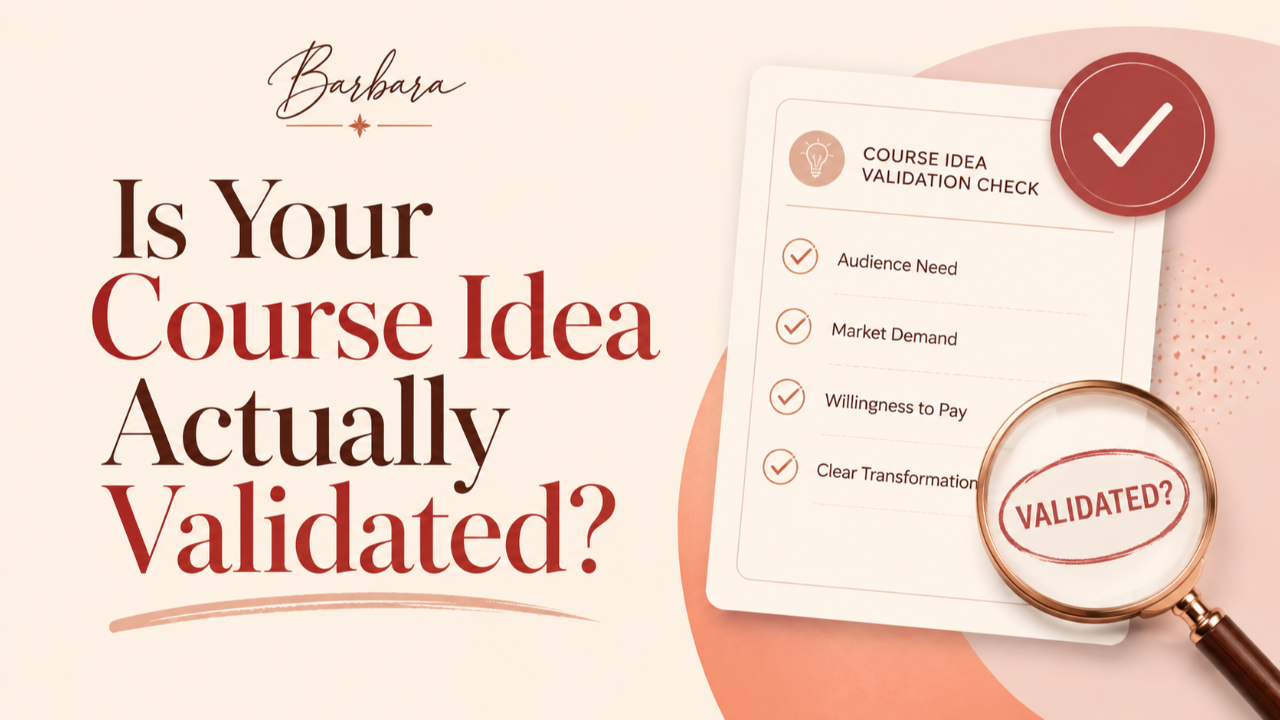
To validate an online course idea, look for evidence that real people already spend time or money trying to solve the problem. Start with customer conversations, then test commitment through a waitlist, presale, live pilot, or paid pilot before investing heavily in building the course.
A course idea is validated by what people do, not by what they say about it. Someone telling you an idea sounds great, or that they'd definitely buy it, isn't evidence the course will sell. Liking an idea and paying for it are different transactions, and only the second one predicts whether a launch works.
This usually isn't a deliberate mistake. The two questions just never got separated, so a warm reaction to the idea got mistaken for proof of demand.
This matters whether you haven't built the course yet, or you built it months ago and it still isn't selling.
Two different questions
"Do you like this idea?" is an opinion question. It's free to answer, free to walk back, and people are polite. Almost everyone will say yes to something that sounds reasonable, especially to your face.
"Will you act on this?" is a different question, and it can only be answered with behavior: money changing hands, time already spent trying to solve the problem, a form filled out, a deposit made, a spot claimed. Behavior is expensive to fake. Opinions aren't.
A course built on the first question and never checked against the second is a guess with good production values.
If you haven't built the course yet
The cheapest validation available costs nothing but a few real conversations, and it doesn't involve pitching anything. Ask people about what they've already done, not what they'd hypothetically do.
- What have they already paid for, trying to solve this problem?
- What's the last thing they tried, and why did they stop?
- How much time have they put into it in the last month?
Those questions surface a real, funded problem, or they don't. Either answer is useful. A room full of "I'd definitely buy that" and nobody who's ever spent a dollar or a weekend on the problem is a warning, not a green light.
Close every conversation with something concrete: a waitlist join, a small deposit, a specific date to follow up. A "maybe, sounds interesting" with no next step isn't a lead. It's a compliment with a longer sentence.
If the course already exists and isn't selling
Finishing a course doesn't validate it. Production effort and market proof are unrelated, so a course can be genuinely well made, well taught, and well produced, and still be answering a question nobody was asking loudly enough to pay for.
This sits earlier than a typical funnel diagnosis. A stuck sales page, a cold list, an unclear offer, those are real and worth finding. But if you fix all of them and the underlying problem was never confirmed as one people already spend money or time trying to solve, the fix won't hold. You'll have repaired a system built on top of an untested assumption.
The tell is usually in the launch data, not the page copy: interest without commitment, people who say the idea sounds helpful and don't act when asked to pay, a list that opens emails about the topic and goes quiet the moment there's a cart. That pattern points backward, past the page, past the offer, to whether the problem itself was ever confirmed.
How to Validate Your Course Idea: 5 Steps
Validation runs as a sequence, not a single test. Each step costs more than the last and proves more than the last, so the goal is to climb only as far as you need for a clear signal.
- A conversation. Costs nothing but someone's time. Proves the problem is real enough that a person has already spent time or money trying to solve it.
- A survey at scale. Confirms whether an audience is actually one group, or several different problems sharing a mailing list.
- A presale. Selling access before anything is built. Proves people will trade money for this specific promise, at this specific price, right now.
- Building it live, with a small paying group. Proves the curriculum itself holds attention and money, not just the pitch that sold it.
- A full paid pilot. Run start to finish before any public launch. The only step that proves the course delivers the result it promises, not just that people were willing to find out.
You don't need all five for every course. Climbing straight to the last step without ever having the first conversation risks producing a beautifully validated answer to a question nobody was actually asking.
The signal that actually counts
Watch for the difference between enthusiasm and commitment. Enthusiasm is comments, likes, "I need this," a full room nodding along. Commitment is a completed action: paid, scheduled, submitted, finished.
The same gap shows up again after launch, in a place fewer people think to check. A course can sell well and still not be validated, if hardly anyone who buys it finishes it. Enrollment answers whether people will pay. Completion answers whether the course works. They're different claims, and only one of them predicts what happens at your next launch.
How to Test Your Course Idea Before Creating the Course
Testing doesn't mean asking whether people like your idea. It means asking for progressively stronger commitments. Start with conversations about past behavior, then move toward actions such as joining a waitlist, paying a deposit, buying a presale, or joining a paid pilot.
Where validation fits in the system
Validation sits earlier than a funnel diagnosis, not instead of one. How to Diagnose Why Your Course Business Isn't Selling and how to find the bottleneck in a course business both start from the assumption that the course was worth building, then work through which layer, niche, list, offer, page, or launch, is actually stuck. Validation is the question that comes before that assumption gets made.
The two lines of inquiry share more than they might seem to. The same conversations that validate a problem before you build often double as voice-of-customer research, the exact language you'll later need for a niche, an offer, and a sales page. Run them once, and let the answer serve both purposes.
If your funnel has already been diagnosed layer by layer and still isn't producing sales, or you haven't built anything yet and want to know whether it's worth starting, that's the earlier question this article is about. Why Is My Online Course Not Selling? is the wider starting point if you're not yet sure which question you're asking.
Common course validation mistakes
- Treating a compliment as a green light. Warm reactions to an idea are the least reliable signal available, precisely because they're the easiest to give.
- Skipping straight to full production. Recording an entire course before a single real conversation about the problem trades a cheap early signal for an expensive late one.
- Reading enrollment as proof the course works. A full cart and a low completion rate is a validated sales page, not a validated course.
- Discounting so steeply that the price stops meaning anything. Selling founding seats at a fraction of the real price confirms people will pay the discounted number, not the one you'll actually charge.
- Over-validating a small, low-stakes idea. If a handful of honest conversations already produced a clear yes or a clear no, more testing isn't rigor. It's stalling.
The short version
An idea people like and an idea people pay for are not the same thing, and the gap between them is where a lot of course businesses quietly lose months. Validation isn't a formality before you build. It's the only way to know, before or after launch, whether the problem underneath the course was ever real enough to fund one.
If you're not sure where your course actually stands, the free Course Validation Check walks through this in order and shows you exactly which step hasn't been cleared yet.
Take the free Course Validation Check
FAQ
How do I validate a course idea before I build it? Talk to five to eight people about what they've already tried and paid for to solve the problem, not about whether they like your idea. Ask about past behavior, never hypothetical intent, and close every conversation with a concrete next step, not just a compliment.
My course already exists and isn't selling. Is that a validation problem or a funnel problem? It can be either, and your launch data usually shows which. If warm, well-matched people show interest but don't act when asked to pay, the gap may sit earlier than the funnel, in whether the underlying problem was ever confirmed as one people already spend time or money trying to solve.
Is a full cart enough to know a course works? No. A full cart tells you people will pay for the promise. It doesn't tell you whether the course delivers on it. Completion rate, not enrollment, is the signal that answers that question.
Do I need an email list to validate a course idea? No. The first and cheapest step is a real conversation, which needs a handful of willing people, not a list. A survey at scale becomes useful once you have an audience large enough to contain more than one hidden sub-group.
How much validation is enough? Enough to produce a clear signal, not a fixed number of steps. A strong yes or an unambiguous no from an early, cheap step means you can stop there. A murky result means it's worth climbing one step further before committing real production time.
What's the difference between validating a course and diagnosing why one isn't selling? Diagnosis assumes the course was worth building and asks which layer, niche, list, offer, page, or launch, is stuck. Validation asks the earlier question: whether the underlying problem was ever confirmed as one people already pay to solve. A course can pass every layer of a funnel diagnosis and still be sitting on an assumption nobody tested.