How to Find the Bottleneck in Your Course Business
Aug 02, 2026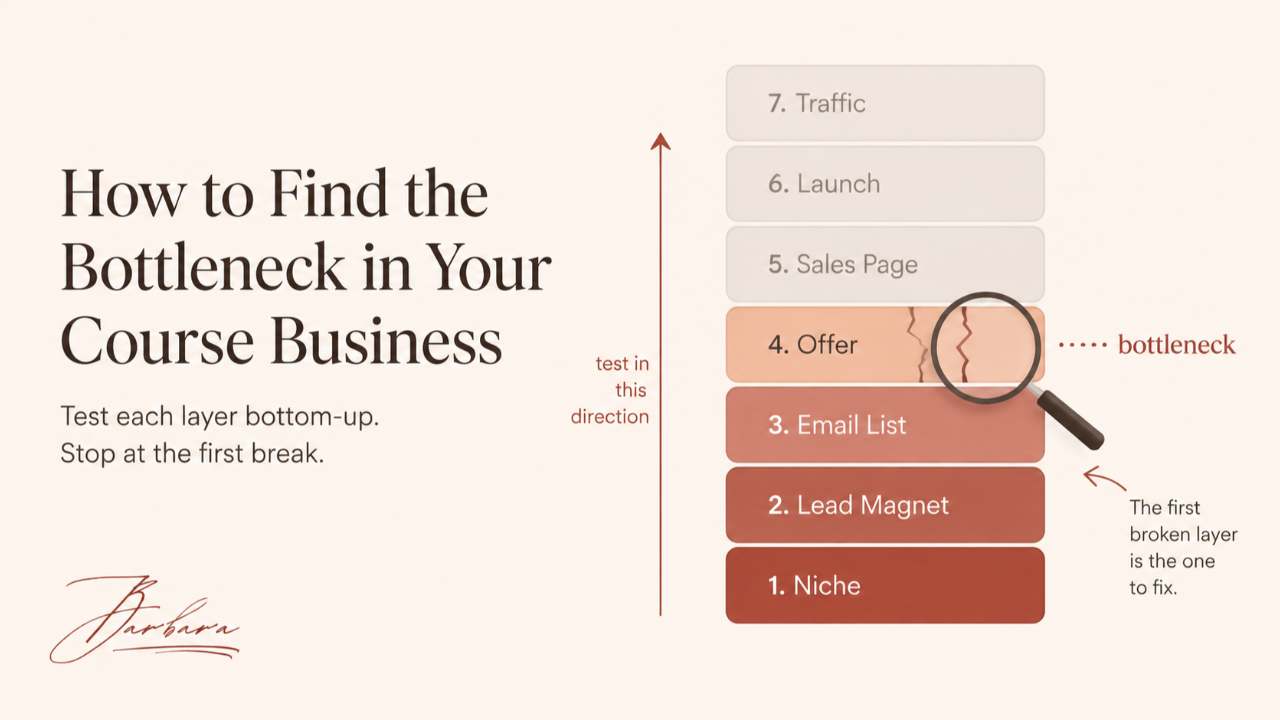
To find the bottleneck in your course business, test each of the seven layers in order from the bottom up, niche, lead magnet, email list, offer, sales page, launch, traffic, and stop at the first one that's broken. That first broken layer is your bottleneck, because every layer sits on the ones below it, and a weak lower layer starves everything above it no matter how strong those upper layers are. You test a layer by asking one question about whether it's doing its job, and comparing what you see to what a healthy version of that layer looks like. The bottleneck is almost never where the pain shows up, so you diagnose in order rather than fixing whatever hurts.
This is a procedure you can run on your own business right now. Here's how each layer works, what to check, and how to know when you've found the break.
The bottleneck is rarely where the pain is
When a course won't sell, the instinct is to fix whatever is visibly failing. The launch flopped, so you rewrite the launch. No sales are coming in, so you go chase more traffic. The sales page isn't converting, so you redesign the page. You attack the pain directly.
The problem is that the visible failure is usually a symptom, not the cause. The launch flopped because the list was cold. The page isn't converting because the offer underneath it is weak. The pain shows up in one layer while the real break sits in a different, usually lower, one. This is the single most important idea in diagnosing a course business, and it's the whole subject of The Symptom Is Rarely the Problem.
So you can't find the bottleneck by chasing whatever hurts. You have to test the layers in order and let the diagnosis tell you where the break actually is, which is what How to Diagnose Why Your Course Business Isn't Selling lays out as a framework and what this article turns into a hands-on procedure.
Fix the lowest broken layer first
Here's the logic that makes the whole method work. The seven layers stack in an order, and each one depends on the layers below it. Niche sits at the bottom. On top of it, lead magnet, then email list, then offer, then sales page, then launch, and finally traffic at the very top.
Because each layer rests on the ones beneath it, a break low in the stack starves everything above it. A vague niche pulls in the wrong subscribers, so the list is full of people who won't buy, so the offer looks like it's failing, so the page looks broken, so the launch flops. One low break, and every layer above it reads as broken too. Which means if you start fixing at the top, you're polishing layers that were never the real problem.
That's why you diagnose from the bottom up and stop at the first break. The first broken layer is the bottleneck, and it's the one to fix, even if layers above it are also weak. You'll get to those, but often they clear on their own once the lower break is fixed, and the ones that don't are a sequencing question that What Should I Fix First in My Funnel? handles. For now, the goal is simply to find the lowest break.
Testing each layer, in order
Here's the procedure. For each layer, there's one question to ask, a picture of what a healthy layer looks like, and a picture of a broken one. Go in order, start at layer one, and stop the moment you hit a break. Don't keep going to catalog everything that's wrong. The first break is your answer.
Layer 1: Niche
Question: When the right person hears who this is for, do they immediately think "that's me"?
Healthy looks like a specific person lighting up because the course is clearly for someone exactly like them. Broken looks like a broad, vague promise, "anyone who wants to grow their business," that no single person feels personally spoken to by. If nobody feels like it's for them specifically, the break is here, and no amount of work above it will compensate. The fix starts with choosing a niche that actually sells, informed by the language real buyers use.
Layer 2: Lead magnet
Question: Are the right people opting in, and do they stay engaged afterward?
Healthy looks like qualified subscribers coming in and then opening and clicking, people who match your future buyer. Broken shows up two ways: very few people opt in at all, or plenty opt in but go silent immediately, which means the magnet attracted the wrong crowd. Both are lead-magnet breaks, and what makes a lead magnet actually convert covers the fix, usually a more specific magnet that delivers a fast first win to exactly the right person.
Layer 3: Email list
Question: Is your list warm, does it open, click, and reply?
Healthy looks like consistent opens, the occasional reply, and general signs that people remember and want to hear from you. Broken looks like low opens, near-total silence, or a list that only ever hears from you when you're selling something. A cold list is one of the most common bottlenecks, and it's fixed by nurturing the list so it stays warm, which is the practical side of how email turns subscribers into buyers.
Layer 4: Offer
Question: Do warm people who clearly understand the offer still decline to buy?
Healthy looks like a reasonable share of engaged, warm people saying yes. Broken looks like plenty of interest but few purchases, or people telling you it's "too expensive" even though they get what it is. When warm people who understand the offer still don't buy, the offer itself is the break, and how to build an offer people can't ignore is where you rebuild it. Price often gets blamed here when the real issue is value, which How to Price Your Online Course sorts out.
Layer 5: Sales page
Question: Do warm people reach the page and leave without buying or without understanding it?
Healthy looks like a page that communicates the offer clearly and converts warm visitors at a reasonable rate for its context. Broken looks like people landing and bouncing, confusion about what's actually being sold, or warm traffic that arrives and doesn't convert. If the offer is strong but the page isn't landing it, the break is on the page, and the anatomy of a sales page that converts shows what's missing, often proof placed next to the doubts it answers.
Layer 6: Launch
Question: When you make a real, time-bound push, does it convert your warm list?
Healthy looks like a launch producing a genuine spike of sales from people who were already warm. Broken looks like a launch met with silence. But be careful here: a launch that flops is usually a symptom of the cold list beneath it, not a launch-mechanics problem, which is exactly why Why Did My Course Launch Fail? and Why a Cold List Sinks a Good Launch both point downward. If the layers below are healthy and the launch itself still misfires, then the break is genuinely in the launch, covered by how to run a launch that doesn't fizzle.
Layer 7: Traffic
Question: Only ask this once every layer below converts, are enough of the right people arriving?
Healthy looks like a steady flow of qualified visitors into a funnel that already turns them into buyers. Broken, genuinely broken, looks like too few of the right people arriving, and only counts once everything below already works. Traffic is last for a reason: pouring more visitors into a funnel that leaks lower down just wastes them. This is the whole point of why traffic is the last thing to fix and why more traffic won't fix your funnel. If you're unsure whether you have too few visitors or a conversion problem, Do I Have a Traffic Problem or a Conversion Problem? settles it.
The first broken layer is the bottleneck
The discipline that makes this work is stopping at the first break. It's tempting to test all seven layers, make a long list of everything that looks wrong, and try to fix it all. Resist that.
The reason is that a low break distorts your read on everything above it. If your list is cold, your offer will look broken, because warm people aren't the ones seeing it. If your offer is weak, your page will look broken, because it's trying to sell something people don't want. So the "breaks" you think you see in the upper layers may be illusions cast by the real break below. You genuinely cannot trust your diagnosis of the upper layers until the lower one is fixed.
So fix the lowest break, then run through the layers again. The system tends to clear from the bottom up, and each fix gives you a truer read on what remains. Diagnosis isn't a one-time list; it's a loop you repeat as each bottleneck is cleared. When you do find multiple genuine breaks, What Should I Fix First in My Funnel? tells you the order to tackle them.
Diagnosing your own business is hard
Here's the honest catch: you are the worst-positioned person to diagnose your own course business, and it's worth knowing why before you start.
You're too close to see it clearly. You can't unsee what you meant your offer to say, so you can't tell whether it lands for a stranger. You defend the layers you worked hardest on, because admitting the break is in the thing you spent three months building is painful. And you tend to blame the layer that's least uncomfortable to blame, which for most people is traffic, because "I just need more eyeballs" doesn't require questioning the offer or the niche you're attached to.
You can counter some of this. Look at what people actually do, the opens, the clicks, the purchases, rather than what you intended. Ask what your warm audience does, not what you hope they'd do. And be deeply suspicious of any diagnosis that conveniently lands on "more traffic," because that's the answer your blind spots want. Still, structured questions asked from the outside, without your attachments, will almost always find the break faster than you can find it yourself.
Common bottleneck-hunting mistakes
- Fixing the pain instead of the cause. The visible failure is usually a symptom of a lower layer. Diagnose in order rather than attacking whatever hurts.
- Starting at the top. Beginning with traffic, or any upper layer, means polishing things that may not be the real break. Start at the bottom.
- Testing out of order. The method only works bottom-up, because lower breaks distort upper layers. Jumping around gives false readings.
- Trying to fix everything at once. A long list of "broken" layers is usually one real break casting shadows. Fix the lowest, then re-check.
- Stopping at the layer you want it to be. It's tempting to declare the bottleneck is the least painful layer to fix. Stop at the first real break, not the convenient one.
- Assuming it's traffic. The most common wrong answer. Traffic is the last layer to suspect, not the first.
- Re-diagnosing without fixing anything. Running the tests repeatedly without acting just relabels the problem. Fix the lowest break before you re-check.
From finding it to fixing it
Finding the bottleneck is step one. Once you've located the lowest broken layer, the framework tells you what to do next: fix that layer using its own playbook, then re-diagnose to see what the fix revealed. If you found several genuine breaks, sequence them with What Should I Fix First in My Funnel? The full conceptual map of how the layers connect is How to Diagnose Why Your Course Business Isn't Selling, and if you're just starting to suspect something's wrong, Why Is My Online Course Not Selling? is the short way in. This procedure is the hands-on entry into that whole system.
The short version
Test your seven layers from the bottom up, niche, lead magnet, list, offer, page, launch, traffic, and stop at the first one that's broken. That first break is your bottleneck, because every layer rests on the ones below it and a low break starves everything above. The pain you feel is rarely the cause, so diagnose in order instead of chasing symptoms. Fix the lowest break, then run through the layers again, and be honest that your own blind spots, especially the urge to blame traffic, are the hardest part.
This procedure is the manual version of what the free Course Business Diagnostic does in a few minutes. It tests each layer in order, stops at the first broken one, and does it without the blind spots that make diagnosing your own business so hard.
Take the free Course Business Diagnostic
FAQ
What if more than one layer is broken? That's common, and it's exactly why you fix the lowest one first. Multiple layers often look broken because a single low break distorts everything above it, so some of those upper "breaks" will clear on their own once the bottom one is fixed. Fix the lowest genuine break, run through the layers again, and see what actually remains. For the breaks that are still real after that, the order to tackle them is covered in What Should I Fix First in My Funnel?
Can the bottleneck really be a layer I thought was fine? Often, yes, and that's the whole reason to test in order rather than trusting your gut. The layers you feel most confident about are frequently the ones you're too close to judge, and the break tends to hide in the layer you'd least expect or least want to question. Testing each layer against a clear standard, instead of assuming, is what surfaces the break you'd otherwise skip right past.
Why start at the niche instead of traffic? Because the niche is the foundation everything else rests on, and traffic is the last layer that can possibly be the real problem. If the niche is vague, it pulls in the wrong people, which breaks every layer above it, so a niche problem masquerades as a list, offer, or traffic problem. Starting at the bottom means you find the true cause instead of a symptom, and you avoid pouring effort, or visitors, into a funnel that leaks lower down.
How do I know when I've actually found the bottleneck? You've found it when you hit the first layer that clearly fails its test while the layers below it pass theirs. If a layer looks broken but something beneath it is also broken, keep going down, the lower one is the real bottleneck. The bottleneck is the lowest layer that genuinely isn't doing its job. Once you fix it and re-diagnose, a true bottleneck fix usually improves the symptoms that were showing up higher in the stack.
Isn't it usually just a traffic problem? Much less often than it feels. Traffic is the answer people reach for first because it's the least uncomfortable to blame, but it's genuinely the problem only when every layer below it already converts. If warm visitors aren't buying, adding more visitors won't help, you'll just lose more of them to the same lower break. Suspect traffic last, and only after the niche, lead magnet, list, offer, page, and launch have all passed their tests.