Why Traffic Is the Last Thing to Fix
Jul 29, 2026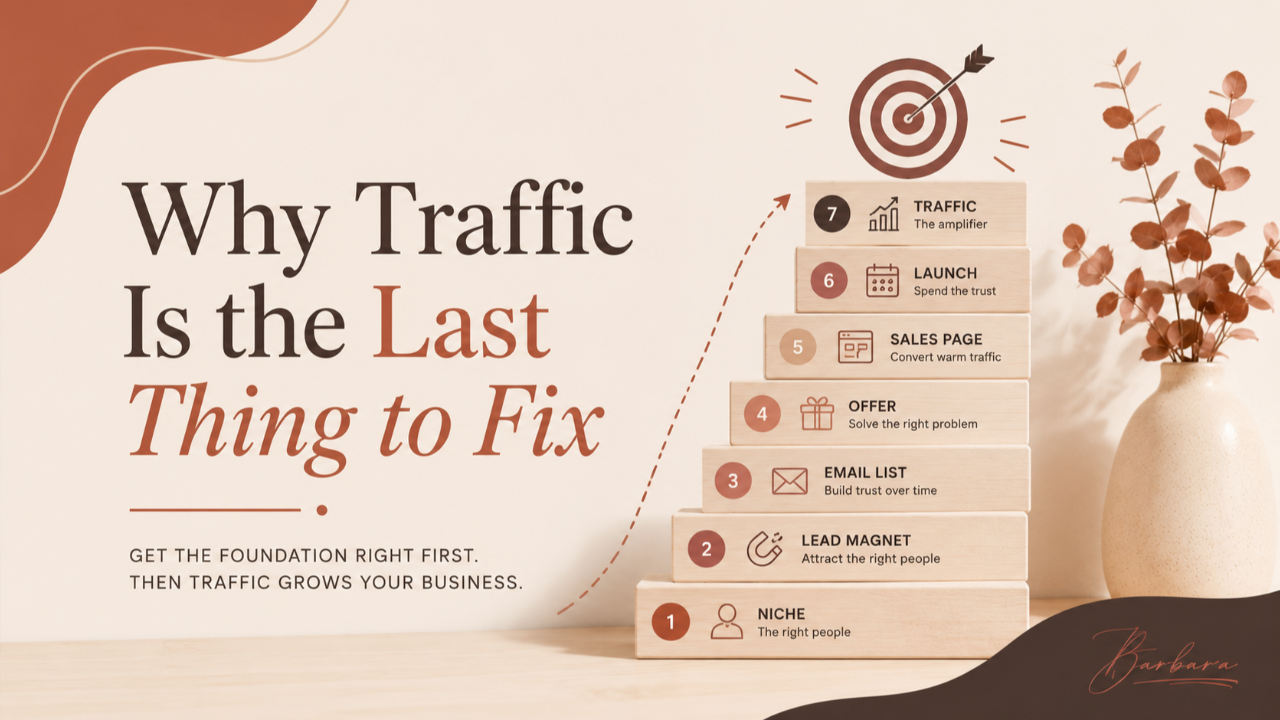
Traffic is the last layer to fix because it multiplies whatever your funnel already does, rather than fixing anything itself. Point traffic at a funnel that converts and it grows the business. Point it at one that leaks and it grows the losses. So the right order is to make the funnel convert first, from a warm audience, and add traffic only once it does. When traffic genuinely is the constraint, the sequence is: start with people who already know you, then one organic channel you commit to, then borrowed audiences, and only then paid ads, and only once each subscriber is worth enough to justify the spend.
That order runs against the strongest instinct in the whole business, which is to reach for more traffic the moment sales are slow. So it's worth understanding why traffic sits where it does before we get to how to do it well.
Traffic is the amplifier, not the engine
In the seven layers of a course business, traffic is the seventh and top layer. It sits above the niche, the lead magnet, the email list, the offer, the sales page, and the launch. Everything else is underneath it, and that position is the whole point.
Traffic is the amplifier on top of the system, not the engine inside it. The engine is the funnel: the layers that turn a stranger into a subscriber, a subscriber into a warm lead, and a warm lead into a buyer. Traffic doesn't do any of that converting. It just decides how many people enter at the top. So when you add traffic, you're turning up the volume on whatever the funnel already does, for better or for worse.
This is why adding traffic to a broken funnel is the most expensive mistake in the whole business. You're paying, per visitor, to send more people into a leak. The funnel wasn't converting the people it already had, and now you're spending money to bring more people who won't convert either. The instinct to fix slow sales with more traffic is understandable, traffic feels like the one lever you can always pull, but it's the most common wrong conclusion there is. The deeper version of this argument is in Why More Traffic Won't Fix Your Funnel, and the plain-language starting point is Why Is My Online Course Not Selling?
Traffic multiplies whatever the funnel already does
Here's the principle at the center of this whole layer, stated plainly.
A funnel is really just a set of conversion rates. Some percentage of visitors opt in. Some percentage of subscribers engage. Some percentage of warm leads buy. Traffic changes one thing and one thing only: the number of people entering at the top. It does not change any of the rates.
So think about what that means. If your rates are bad, more people just means more of them falling through the same gaps, and each one cost you something to bring in. If your rates are good, more people means proportionally more sales. Traffic is a multiplier, and multiplying a broken funnel by a bigger number still gives you a broken funnel, now with a bill attached. Multiplying a working funnel by a bigger number gives you real growth.
That's the entire reason traffic is diagnosed last and fixed last. Until the rates underneath are healthy, spending to increase the volume on top is spending to lose money faster. The question of whether your problem is the rates or the volume is common enough to have its own guide: Do I Have a Traffic Problem or a Conversion Problem? walks the test.
How to know traffic is actually your constraint
Traffic is the last thing to fix, but sometimes it genuinely is the thing to fix. The trick is knowing when, and the answer is specific.
Traffic is genuinely your constraint only when the funnel already converts at a reasonable rate from the people it currently gets. That means: a healthy share of visitors opt in, the list actually engages with your emails, the offer sells to a warm list, and the sales page converts the warm traffic that reaches it. When every rate along the way is healthy and the only shortfall is that too few people are entering at the top, then, and only then, is traffic the right lever to pull.
Notice how high that bar is. Every layer beneath traffic has to be working before traffic is the answer. If opt-ins are weak, that's the lead magnet. If the list doesn't engage, that's the email layer. If warm people don't buy, that's the offer or the sales page. Any one of those failing means the constraint is there, not at traffic. Only when all of them pass does the shortfall of people at the top become the real bottleneck.
The order to add traffic, from warm to paid
Once the funnel converts and traffic really is the constraint, there's a right order to adding it. Think of it as a ladder you climb from the warmest, cheapest traffic to the coldest, most expensive, and you climb it in sequence.
Warm outreach first. Your very first buyers almost always come from people who already know you, personally or through your existing audience. It's the least comfortable option and the fastest one, and it does something no ad can: it produces your first real testimonials and case results, which make every later rung work better. Start here, however small it feels.
One organic channel, committed. Pick a single platform and one steady rhythm of substantial content, and go deep on it for many months before you even think about adding a second. The mistake here is spreading thin across five channels at once, none of which gets enough consistency to compound. Build the library on one channel first; reach follows depth, not the other way around.
Borrowed audiences. Once you have proof and a body of work, grow through other people's trust: guesting on podcasts, appearing in newsletters, partnering with people who serve a similar audience. You're borrowing an audience someone else spent years earning, which is far cheaper than buying attention cold.
Paid traffic, last. Ads come last, not because they're bad, but because they only pay off on top of a funnel that already converts and economics that already work. Paid traffic is the rung you climb once the ones below it are solid, never the one you jump to first.
You climb this ladder in order. Skipping straight to paid before the lower rungs are in place is the classic expensive mistake, and it's the reason so many first ad campaigns quietly lose money.
Don't pay for traffic until the numbers say yes
Paid traffic deserves its own gate, because it's where the money gets spent fastest. Before you run ads, two things need to be true.
First, the funnel converts warm traffic at a reasonable rate. If it hasn't yet converted the warm, free traffic you already have, cold paid traffic will convert worse, not better, and you'll be paying to learn that.
Second, each subscriber is worth enough over time to justify what you'd pay to acquire one. This is where earnings per subscriber comes in. It's a simple idea: roughly, your total revenue divided by the size of your list, which tells you what an average subscriber is worth to your business. If a subscriber is worth more than it costs you to acquire one through ads, paid traffic can make money. If a subscriber is worth less than that, paid traffic loses money on every single acquisition, no matter how much you spend or how well you target. Below that line, more ad spend just means larger losses.
The exact numbers, where the line sits and how to calculate it properly, are worth their own treatment, and the specifics live in the earnings-per-subscriber breakdown and the readiness guide for paid traffic. The principle to hold onto here is simpler: don't pay to acquire subscribers who are worth less than they cost. Get the funnel converting and the per-subscriber value up first, then the ads have something to multiply.
What to do instead of buying traffic right now
If you came to this article convinced you need more traffic, here's the honest redirect: the higher-leverage move is almost always to fix the funnel first.
Start by finding the layer that's actually leaking. Walk the seven layers in order and find the first one that isn't converting, which is exactly what How to Diagnose Why Your Course Business Isn't Selling is for, and if several look weak, What Should I Fix First in My Funnel? tells you which to repair first. Seal that leak. Then do warm outreach and commit to one organic channel. Only after all of that, and only if volume is genuinely the remaining constraint, do you reach for paid traffic.
This feels slower, and it is slower in the first month. But it's far cheaper over any real timeframe. Months of consistent organic effort on top of a funnel that converts will out-earn an ad budget poured into a leak, every time. Patience here isn't just virtue, it's the cheaper path.
Common traffic mistakes
- Buying ads to rescue a funnel that doesn't convert. Ads multiply a leak into a bigger, costlier leak. Fix the rates first.
- Spreading across many channels at once. Five half-tended channels compound nothing. One committed channel compounds.
- Skipping warm outreach because it's uncomfortable. It's the fastest path to your first buyers and the testimonials that power everything after.
- Treating traffic as the first fix instead of the last. It's the top layer, so it's the last one to diagnose and the last one to fix.
- Judging your funnel on cold paid traffic. If it never converted warm traffic, cold traffic tells you nothing except how fast you can spend.
- Paying for traffic before the per-subscriber math works. If a subscriber is worth less than they cost to acquire, every ad dollar loses money.
Where traffic sits in the system
Traffic is the top layer, and everything else is underneath it. That single fact explains its whole role: it can only multiply what the six layers below already do. It adds people; it does not add conversion.
This is why nearly every self-diagnosed "traffic problem" turns out to be a conversion problem one or more layers down. The pain looks like "not enough people," but the cause is usually that the people you already have aren't converting, which is a niche, lead magnet, list, offer, or page problem wearing a traffic costume. It's the same lesson that runs through the entire framework, that the symptom is rarely the problem, applied to the layer people most love to blame. The companion argument, laid out in full, is Why More Traffic Won't Fix Your Funnel, and the fork for telling the two apart is Do I Have a Traffic Problem or a Conversion Problem?
When traffic does multiply a working funnel, look at everything it's multiplying: a sharp niche, a lead magnet that brings the right people, a warm list, a strong offer, a page that confirms, and a launch that spends the trust well. Get those right and traffic is worth every dollar. Skip them and it's worth less than nothing.
The short version
Traffic multiplies whatever your funnel already does, so it's the last layer to fix, not the first. Make the funnel convert from a warm audience, then climb the ladder in order: warm outreach, one committed organic channel, borrowed audiences, and paid ads last, only once each subscriber is worth more than they cost to acquire. Fix the engine before you turn up the volume, and traffic multiplies sales instead of losses.
Before you spend a dollar on traffic, run the free Course Business Diagnostic to confirm your funnel converts, so traffic multiplies sales instead of losses.
Take the free Course Business Diagnostic
FAQ
How much traffic do I actually need? Less than you'd think, if your funnel converts, and no amount is enough if it doesn't. A converting funnel turns a modest, steady stream of the right visitors into real sales, while a leaky one wastes any volume you send it. So the useful question isn't "how much traffic," it's "does my funnel convert the traffic I already have." Get the rates healthy first, and you'll usually find you need far less traffic than you assumed.
Should I run ads to grow my email list? Only once the list you already have converts, and once a subscriber is worth more than it costs to acquire one. Running ads to grow a list that doesn't buy just builds a bigger list that doesn't buy, at a cost per name. Prove the funnel converts warm subscribers into buyers first; then paid list growth can make sense, because you're multiplying something that already works rather than paying to enlarge a leak.
What's the cheapest way to get traffic to my course? The people who already know you, followed by one organic channel you commit to for the long haul. Warm outreach costs nothing but discomfort and tends to produce your first buyers and testimonials fastest. One consistent organic channel is the next cheapest, because it compounds over months. Paid traffic is the most expensive, which is exactly why it comes last, after the cheaper rungs have done their work.
How do I know if my funnel is ready for paid traffic? When it already converts warm traffic at a reasonable rate at every step, and when an average subscriber is worth more to your business than it costs to acquire one through ads. If warm, free traffic converts and the per-subscriber economics are positive, paid traffic can pour fuel on a working fire. If either isn't true yet, ads will lose money, so the readiness test is really a test of the layers beneath traffic, not of traffic itself.
Why did my ads not lead to sales? Almost always because the funnel underneath wasn't converting before you turned the ads on. Ads brought more people to the same pages, opt-ins, and offer that weren't converting the visitors you already had, so more visitors produced more non-buyers at a cost. The fix isn't better ads or more spend; it's finding and sealing the leak in the funnel first, then letting the ads multiply a funnel that actually works.