Do I Have a Traffic Problem or a Conversion Problem?
Jul 27, 2026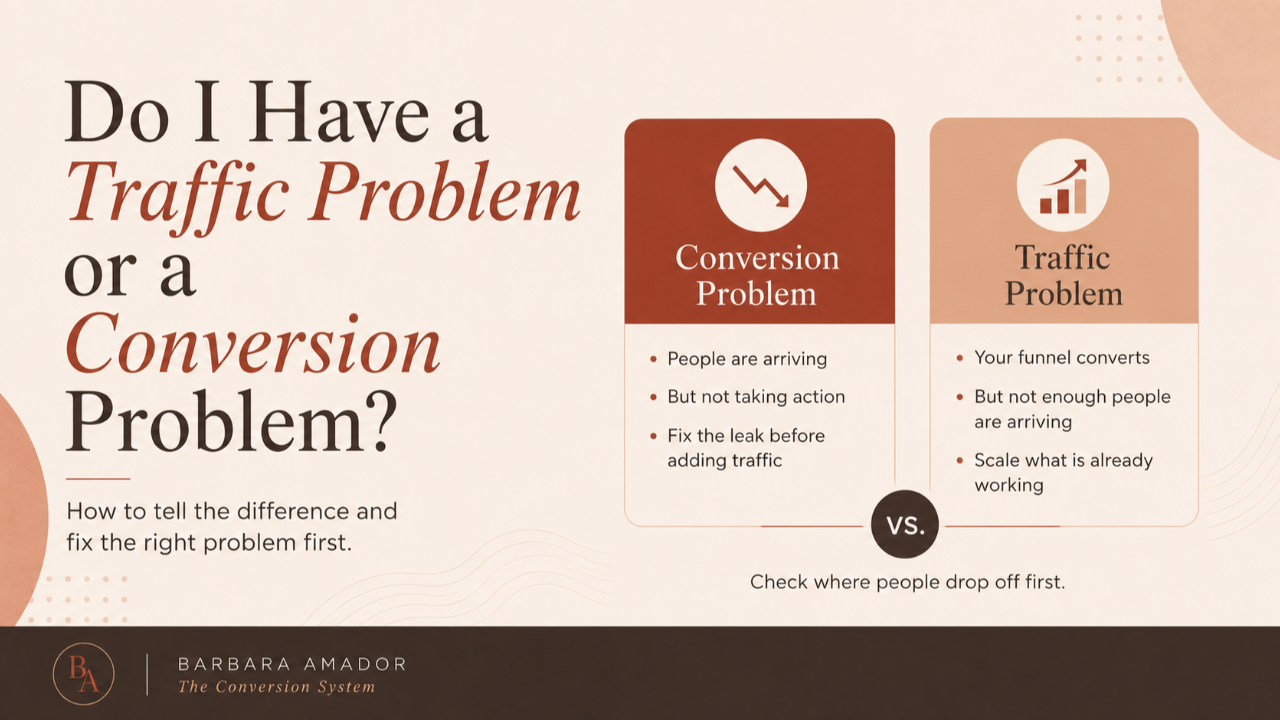
You have a conversion problem, not a traffic problem, if people are already arriving and not buying. The test is simple. Look at whether the visitors you already get are converting at each step. If people reach your pages and leave without opting in or buying, more traffic will just send more people to the same leak. You only have a true traffic problem when your funnel already converts at a reasonable rate and the one thing missing is enough of the right people showing up. For almost everyone who thinks they need more traffic, the real constraint is conversion.
That distinction is worth getting right, because the two problems have opposite solutions. One is fixed by getting more people. The other is made worse by it.
Why this is the most expensive question to get wrong
Most questions about your course business cost you time when you answer them wrong. This one costs you money, directly and quickly.
Here's why. If your funnel doesn't convert and you decide the problem is traffic, your fix is to go buy visitors. So you spend on ads. More people arrive, they hit the same leaky funnel, and they leave the same way the last ones did. You haven't fixed anything. You've just paid to watch more people bounce. The worse your conversion, the more each new visitor costs you and the less each one returns.
This is the clearest example of the idea behind the whole Conversion System: more traffic will not fix a problem that lives earlier in the system. Traffic multiplies whatever your funnel already does. Point it at something that converts and it grows your business. Point it at something that leaks and it grows your losses. So before you spend a dollar getting more people, you need to know the people you already have are converting.
What each problem actually looks like
The two problems look different once you know what to watch for. Put them side by side.
| Signal | Conversion problem | Traffic problem |
|---|---|---|
| What it is | A rate problem | A volume problem |
| Are people arriving? | Visitors are arriving | Very few people are arriving |
| Do they opt in? | They leave without opting in | A reasonable share opt in |
| Does the list engage? | The list never opens or clicks | The list engages |
| Do they buy? | The list is warm, but almost no one buys | When you make an offer, some of them buy |
| The read | The traffic is doing its job. The funnel isn't. | The rates are fine at every step. There just aren't enough people. |
| What more traffic does | Sends more people to the same leak | Exactly what you need |
A conversion problem looks like this. Visitors are arriving, but they leave without opting in. Or they opt in, but the list never opens or clicks. Or the list is warm, but when you make an offer, almost no one buys. Or people reach your sales page and leave without purchasing. In every version, people are showing up and something downstream is failing to move them to the next step. The traffic is doing its job. The funnel isn't.
A traffic problem looks like this. When someone does come through, the funnel works. A reasonable share of visitors opt in. The list engages. When you make an offer, some of them buy. The rates are fine at every step. The only issue is that very few people are arriving in the first place, so even good rates produce small numbers.
Notice the difference. A conversion problem is a rate problem: people arrive and the percentages fall apart. A traffic problem is a volume problem: the percentages are fine and there just aren't enough people. If your rates are broken, more volume won't help. If your rates are healthy, more volume is exactly what you need.
Where a "traffic problem" usually hides
Most self-diagnosed traffic problems are conversion problems one or more layers down. The reason it feels like traffic is that low sales and low traffic produce the same surface symptom: not enough money coming in. But the cause is usually further back in the system.
It might be your niche. If your niche is too broad, you may be pulling in visitors who were never the right fit, so they arrive and leave. That looks like weak traffic. It's actually a targeting problem at the foundation. How to Choose a Course Niche That Actually Sells covers how to sharpen it.
It might be your lead magnet. If the visitors you already have aren't opting in, the problem isn't that you need more visitors. It's that the ones you have aren't being converted into subscribers. What Makes a Lead Magnet Actually Convert covers how to fix that.
It might be your offer. If your list is warm and engaged and still doesn't buy, no amount of new traffic changes that. Warm people are saying no, and more warm people will say no too, until the offer itself is stronger. How to Build an Offer People Can't Ignore covers how to fix that.
In each case, the instinct to buy traffic is treating a symptom that started somewhere else. That's why you trace it back before you spend.
A two-minute test
Here's a sequence you can run right now to tell which problem you have. Follow the visitor through your funnel and watch for the first place the rate falls off a cliff.
- Are people reaching your pages at all? If truly almost no one is arriving, note that, but don't stop here. You still need to know whether the trickle who do arrive convert.
- Of the visitors who arrive, what share opt in? If people are landing and very few join your list, that's a conversion problem at the lead magnet, not a traffic problem.
- Of the people on your list, are they opening and clicking? A quiet, disengaged list is a conversion problem at the email layer. More subscribers won't fix a relationship problem.
- Of the people who reach your sales page, what share buy? If warm people reach the page and leave, the leak is at the offer or the page.
The first step where the rate collapses is your conversion problem, and it names the exact layer. If instead every rate is reasonable and the only issue is small numbers at the very top, then you have a genuine traffic problem, and now it's worth solving.
If you'd rather not eyeball this, the free Course Business Diagnostic runs this same sequence and tells you the exact layer that's leaking.
What to do with your answer
If the answer is conversion, put the traffic plan down. Go to the layer where the rate collapsed and fix that first. Spending on ads before that leak is sealed is how you turn a slow month into an expensive one. Fix the right part of the system first, then judge whether you still need traffic.
If the answer is genuinely traffic, then the traffic work is worth doing, and there's a right order to it. Start with the people who already know you and one channel you can commit to, before you reach for paid ads. And there's a simple gate for paid traffic: your earnings per subscriber, which tells you whether your list is worth enough per person to spend to grow it. Below a certain point, paid traffic loses money no matter how much you buy. What Is Earnings Per Subscriber (EPS)? and When Are You Ready to Pay for Traffic? cover exactly where that line sits. And the full case for why traffic comes last is in Why Traffic Is the Last Thing to Fix.
Common mistakes at this fork
- Assuming low sales means low traffic. They produce the same symptom, but they have opposite fixes. Check the rates before you decide.
- Buying ads to "test" an unproven funnel. If the funnel hasn't converted organic visitors yet, paid visitors won't convert either, and now you're paying to learn that.
- Judging conversion on tiny numbers. If only a handful of people have come through, you don't have enough information to call your rates good or bad yet. Get a little more volume before you conclude anything.
- Choosing traffic because it feels more actionable. Buying ads feels like doing something. Rebuilding an offer feels like admitting the offer was the problem. The comfortable choice and the correct one are often different here.
How this connects to the rest of the system
This whole question is one specific application of the larger diagnostic method. The full version walks all seven layers in order and finds the first one that's stuck. Traffic versus conversion is just the most common fork people hit, because traffic is the layer everyone reaches for first. If you want the complete sequence, start with How to Diagnose Why Your Course Business Isn't Selling, and if you want the plain-language version of why courses stall, Why Is My Online Course Not Selling? is the shortest way in.
And if you run the test and find more than one leak, don't try to seal them all at once. There's an order to that too. What Should I Fix First in My Funnel? covers how to pick the first fix when several layers are weak. The deeper reason more visitors rarely rescue a struggling funnel is spelled out in Why More Traffic Won't Fix Your Funnel.
The short version
If the visitors you already have aren't converting, you have a conversion problem, and more traffic will make it more expensive, not better. If your funnel already converts at a reasonable rate and you simply need more people, then you have a traffic problem, and it's finally worth spending on. The test is whether your existing visitors are moving through your funnel. Run that first. Buy traffic second, if at all.
Not sure where your funnel is leaking? The free Course Business Diagnostic finds the exact layer, so you know whether to fix your conversion or go get traffic.
Take the free Course Business Diagnostic
FAQ
How much traffic do I need before I can judge my conversion rate? Enough that the numbers mean something. A page that's had ten visitors can't tell you whether it converts; a page that's had a few hundred can start to. You don't need a statistics background, just enough people through each step that the rate would hold steady if a few more arrived. If your numbers are still tiny, the honest answer is that you don't know your conversion rate yet, and the first job is getting a bit more volume so you can read it. It also helps to remember that what counts as a good conversion rate depends entirely on your traffic and price, so there's no universal number to measure yourself against anyway.
Can I have a traffic problem and a conversion problem at the same time? You can, but you fix conversion first anyway. If your funnel leaks and you also don't get many visitors, sealing the leak before you add traffic means every new visitor is worth more when they arrive. Fixing traffic first just sends more people through the leak. So even when both are true, the order is the same: conversion, then traffic.
Isn't more traffic always good? Only if your funnel converts. More traffic into a working funnel grows the business. More traffic into a leaky one grows the cost without growing the results, because you're paying to send people to something that doesn't move them to buy. Traffic amplifies whatever it points at, so it's good or bad depending entirely on what's underneath it.
How do I know if my niche is the reason my traffic isn't converting? A niche problem usually shows up as visitors who arrive and leave fast without engaging, because they were never quite the right people. If your content or ads are pulling a broad, mixed audience, plenty may show up and few may fit, which reads as a traffic problem but is really a targeting one. Tightening the niche so the right person recognizes themselves often lifts conversion without adding a single visitor.