What Is Earnings Per Subscriber (EPS)?
Jul 29, 2026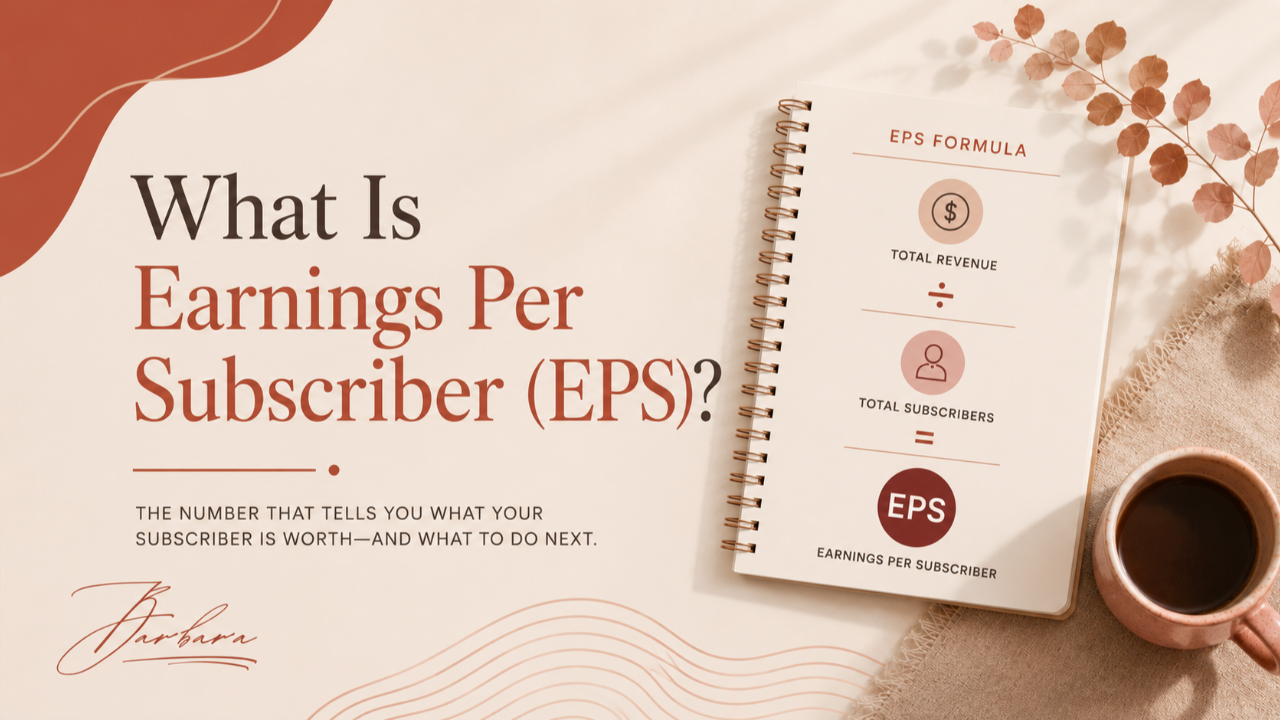
Earnings per subscriber, or EPS, is the total revenue your email list has produced divided by the number of subscribers on it. It tells you, on average, what a single subscriber is worth to your business. The number matters most for one decision: whether you can afford to pay for traffic. If a subscriber is worth more than it costs you to acquire one, paid growth can make money; if less, it loses money on every acquisition. EPS is a health signal for the whole funnel, not just the list, because a low number usually means a lower layer isn't converting, not that you need more subscribers.
It's a small number that answers a surprisingly large question, so it's worth understanding exactly what it is and, more importantly, what it's telling you.
The simplest version of the number
EPS is just total revenue from your list divided by the number of people on it.
Here's an illustration, with round, made-up numbers to keep it clear. If a list of 1,000 subscribers has produced $2,000 in revenue, the EPS is $2 per subscriber. If that same list had produced $10,000, the EPS would be $10. Same list size, very different picture of what each subscriber is worth. (Those figures are illustrations, not targets. There's no universal "right" EPS, for reasons we'll get to.)
Two inputs go into it: the revenue your list has generated, and the number of subscribers. The one thing to decide is the time window. Some people calculate EPS over all time, some annually, some per launch. None is more correct than the others, but you have to pick one and stay consistent, because an all-time EPS and a per-launch EPS are completely different numbers and comparing them tells you nothing. Consistency matters far more than which window you choose.
What EPS actually tells you
EPS is the clearest single read on whether your email list is a real asset or just a count of addresses. A big list with a low EPS isn't worth much. A small list with a high EPS is worth a great deal. The number cuts straight through the vanity of list size to the thing that actually matters: are these people worth anything to the business.
It sits at an interesting spot in the system, right between two layers. It measures how well your list converts, which depends on the email layer and the offer and page beneath it. And it gates the layer above, traffic, by telling you whether you can afford to pay for more subscribers. That's why EPS is so useful: it reads several layers at once through the lens of the list. If you want to see how the list actually turns into revenue in the first place, How Email Turns Subscribers Into Buyers covers the layer EPS is measuring.
EPS and whether you can afford ads
The main practical job of EPS is to answer one question: can you afford to pay for traffic?
Paid traffic only makes money when a subscriber is worth more than it costs to acquire one. EPS is the "worth" side of that comparison. The other side is your cost to acquire a subscriber through ads. Put them next to each other. If your EPS is comfortably above what it costs you to bring in one new subscriber, paid growth can work, because each subscriber returns more than they cost. If your EPS is below that cost, every paid subscriber loses money, and no amount of spending or clever targeting changes that. You'd just be buying subscribers for more than they're worth.
This is exactly the gate that Why Traffic Is the Last Thing to Fix and Why More Traffic Won't Fix Your Funnel point to. Notice that the test is a comparison, not a fixed threshold. There's no universal EPS number that means "ready for ads," because it depends entirely on what it costs you to acquire a subscriber, which varies by niche, channel, and offer. Anyone who tells you a single magic EPS figure is skipping the comparison that actually matters. The full readiness decision, including timing and the other conditions beyond this one number, is its own topic, covered in the guide on when you're ready to pay for traffic.
A low number is a funnel signal, not a list-size problem
Here's the most useful thing to understand about EPS, and the part most people get backwards.
When your EPS is low, the instinct is to read it as "I don't have enough subscribers." But EPS is revenue divided by subscribers, so a low number almost never means you need more people. It means the people you have aren't producing enough revenue, which is a conversion problem, not a size problem. Adding more subscribers to a list that doesn't convert just adds more non-buyers and pushes EPS down further.
So treat a low EPS as a diagnostic prompt that sends you down the layers, not out for more traffic. A low number usually traces to one of a few places: a cold list that was never warmed into buyers, a weak offer that warm people still decline, a sales page that doesn't convert the people who reach it, or a lead magnet that brought in the wrong people in the first place. Each of those depresses EPS, and each is fixed by repairing that layer, not by chasing subscribers.
This is the same discipline that runs through the whole framework: diagnose before you optimize, and fix the lowest broken layer first. A low EPS is one of the clearest nudges to do exactly that. If you're not sure which layer is dragging it down, How to Diagnose Why Your Course Business Isn't Selling walks all seven in order, and What Should I Fix First in My Funnel? helps when more than one looks weak.
Raising the number without adding a single subscriber
Because EPS is revenue over subscribers, there are two ways to raise it: make more revenue from the list you have, or, counterintuitively, stop adding subscribers who don't convert. The first is where the real gains are.
You lift the revenue side by fixing the layers that turn subscribers into buyers. Warm the list so it actually buys when you make an offer. Strengthen the offer so more warm people say yes. Improve the page so it converts the traffic it already gets. And add an ascension step so existing buyers can buy something again, which raises revenue without needing a single new name. Every one of those lifts EPS using the audience you already have.
The flip side is worth stating plainly: adding subscribers who don't convert actively lowers your EPS, because you're growing the denominator without growing the numerator. This is why chasing list size for its own sake is so often counterproductive. A smaller, warmer, better-converting list can have a far higher EPS than a big cold one, and it's the higher-EPS list that can actually afford to grow with paid traffic. You usually need less list than you think and more conversion than you'd like to admit.
Common mistakes with EPS
- Chasing list size while EPS falls. A bigger list with a lower EPS is often a step backward, not forward.
- Comparing your EPS to someone else's. Different windows, prices, and business models make cross-comparisons meaningless. Compare your EPS to your own acquisition cost, not to a number you saw online.
- Reading a low EPS as "need more traffic." It almost always means "the list isn't converting," which is a lower-layer problem.
- Measuring it inconsistently. Mixing all-time and per-launch windows produces numbers that can't be compared, even to your own past.
- Paying for traffic before EPS clears your acquisition cost. That's buying subscribers for more than they're worth, on purpose.
- Never calculating it at all. Spending on ads without knowing your EPS is flying blind on whether the spend can ever pay back.
Where EPS sits in the system
EPS isn't really one of the seven layers. It's a gauge on the system, read through the list. It rises when the layers below it convert, the niche, lead magnet, email, offer, and page all feed it, and it gates the layer above it, traffic, by telling you whether you can afford to buy more subscribers.
That's what makes it such a useful single number. It quietly summarizes how well the bottom of your funnel is working and hands you a clear yes-or-no on the top of it. If you want the layer it most directly measures, that's the email list; the decision it most directly informs is traffic; and the map of how all of it connects is the full diagnostic.
The short version
EPS is revenue divided by subscribers, and it tells you what one subscriber is worth. Its main job is gating paid traffic: you can afford ads when a subscriber is worth more than it costs to acquire one. And a low EPS points you down the layers, to a cold list, a weak offer, or a page that doesn't convert, not out for more subscribers. Raise revenue from the list you already have, and the number takes care of itself.
If your EPS is low and you're not sure which layer is dragging it down, the free Course Business Diagnostic finds the one to fix first.
Take the free Course Business Diagnostic
FAQ
What's a good EPS? There isn't a universal good number, because what counts as healthy depends entirely on what it costs you to acquire a subscriber. An EPS that's plenty for one business is a loss-maker for another with higher acquisition costs. So the useful comparison is your EPS against your own cost to bring in a subscriber, not your EPS against a figure you saw quoted somewhere. If it's comfortably above your acquisition cost, it's good enough to grow on.
How do I calculate EPS? Divide the revenue your list has produced by the number of subscribers on it. The only real decision is the time window, all-time, annual, or per-launch, and the rule there is to pick one and stay consistent, so your numbers are comparable over time. Keep the two inputs measured the same way each time and the trend will tell you more than any single snapshot.
Is EPS the same as customer lifetime value? No, though they're related. Lifetime value measures what a single buyer is worth over the whole time they buy from you. EPS measures what an average subscriber is worth, and most subscribers never buy, so EPS is a broader, lower number spread across your whole list. LTV tells you about your buyers; EPS tells you about your list. Both are useful, for different decisions.
How often should I check my EPS? Often enough to see the trend, and especially before any decision about paid traffic. Checking it after major changes, a new offer, a warming push on the list, a launch, shows you whether those changes moved the number. You don't need to watch it daily; the trend over months, measured consistently, is what matters, along with a fresh look before you consider spending to grow.
Does a bigger list mean a higher EPS? Usually the opposite, if the new subscribers don't convert. Because EPS divides revenue by subscriber count, adding people who don't buy grows the denominator without growing the numerator, which pulls EPS down. A bigger list only raises EPS if the new subscribers are as valuable as the existing ones. This is why growing list size for its own sake can quietly make your list less valuable per person, not more.