Why More Traffic Won't Fix Your Funnel
Jul 28, 2026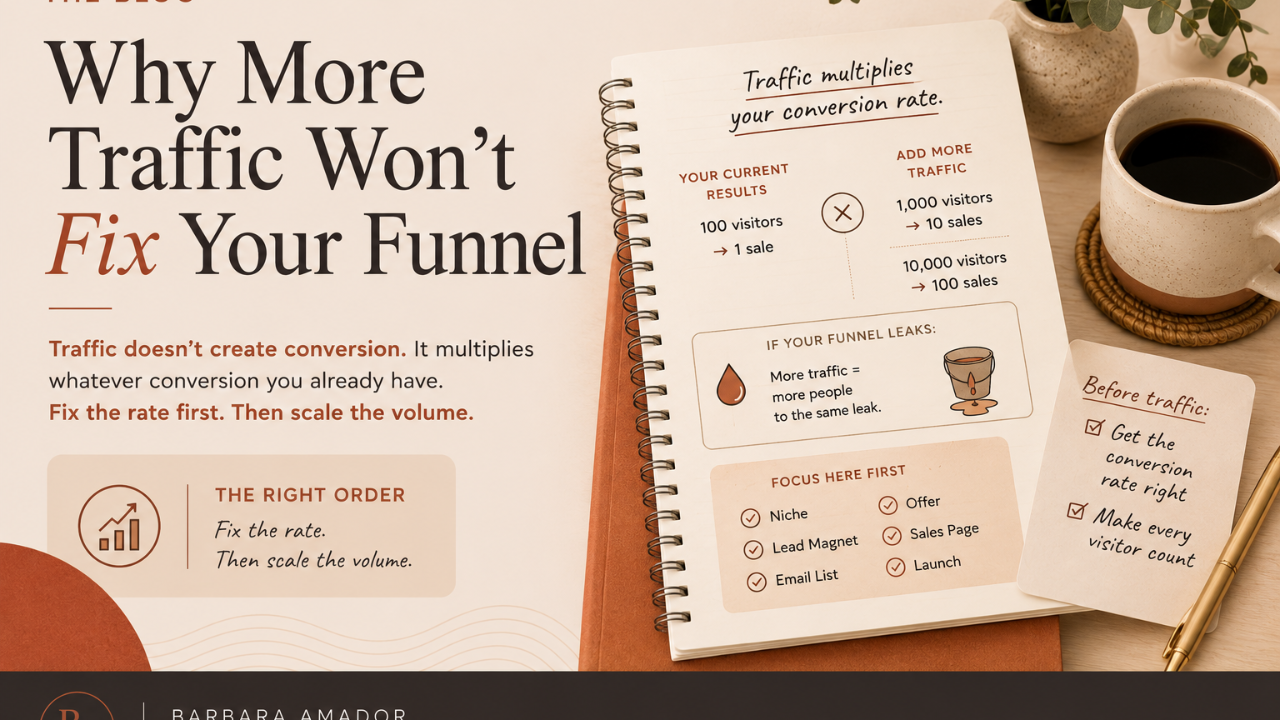
More traffic won't fix your funnel, because traffic doesn't create conversion. It multiplies whatever conversion you already have. If your funnel turns visitors into buyers, more traffic grows the business. If it doesn't, more traffic just sends more people to the same leak, at a higher cost. That's why traffic is almost never the right first fix. The right first fix is whatever is stopping the visitors you already have from converting, and you add traffic only once that's working.
This is one of the most counterintuitive ideas in running a course business, and one of the most expensive to get wrong. So it's worth slowing down on.
Why traffic feels like the answer
When sales are slow, traffic is the first thing most people reach for, and it's easy to see why. Traffic feels like the one lever that's always available. You can always find another place to post, another audience to borrow, another ad to run. Compared to the murky work of figuring out why people aren't buying, "get more visitors" feels concrete and doable.
It's also the thing everyone talks about. Follower counts, reach, going viral, ad budgets. The whole conversation around growing a business online is loud about traffic and quiet about conversion. So when something isn't working, traffic is the answer sitting right on top of the pile.
The problem is that reaching for the always-available lever, when the actual problem is somewhere else, is how people spend money making a leak bigger. The appeal is real. It's just usually pointed at the wrong thing.
Traffic is a multiplier, not a fix
Here's the idea underneath everything. Traffic doesn't have a conversion rate of its own. It inherits your funnel's rate and scales it.
Suppose 100 visitors currently produce 1 sale. If you send 1,000 visitors through the same funnel, you get about 10 sales. Send 10,000 and you get about 100. The rate never changed. You just paid to keep it running at scale. Traffic took the result you already had and multiplied it.
That multiplication works in both directions, which is the part people miss. If your funnel makes money on each visitor, multiplying is wonderful, more visitors, more profit. But if your funnel loses money on each visitor, or barely breaks even, multiplying is a problem. More visitors means more loss, faster. A leak doesn't seal when you pour more water through it. It just spills more.
This is why traffic is the last lever to pull, not the first. It's an amplifier. Amplifiers make whatever you feed them louder, and if what you're feeding in is a funnel that doesn't convert, all you get is a louder version of not converting.
How to tell traffic isn't your problem
There's a quick way to check. Look at the visitors you already have.
If people are already reaching your pages and not converting, more of them won't change the rate. A page that turns away the visitors it has now will turn away the visitors you pay for later, in the same proportion. If your opt-in rate is weak, or your list doesn't engage, or your sales page gets visits but not sales, that weakness travels with every new visitor you add. You're not missing traffic. You're missing conversion, and traffic can't supply it.
The full version of this check, the one that tells traffic and conversion apart step by step, is in Do I Have a Traffic Problem or a Conversion Problem?. It's the companion to this article: this one explains why traffic multiplies, that one gives you the test to run.
What to fix instead
If traffic isn't the fix, the work is to find where your existing visitors fall off, and repair that. Follow someone through your funnel from the top and watch for the first place the rate collapses. That layer, the first real drop, is what's actually costing you sales. Fix it, and every visitor you already have becomes worth more, and every future visitor will be too.
The full sequence for finding that layer runs from the bottom of the system up, and it's laid out in How to Diagnose Why Your Course Business Isn't Selling. If you turn up more than one weak spot, What Should I Fix First in My Funnel? tells you which to repair first. The order is always the same: fix the rate, then scale the volume.
When traffic actually is the answer
To be fair, there is a time when traffic is exactly the right move. When your funnel already converts at a reasonable rate, when visitors opt in, your list engages, and your offer sells, and the only thing limiting you is that not enough people are arriving, then you have a real traffic problem, and adding traffic is the correct fix. At that point you're multiplying something that works, which is the whole point.
Even then, there's a gate and an order. The gate is simple: your list has to be worth enough per subscriber to justify spending money to grow it. Below a certain point, paid traffic loses money no matter how good your funnel is. What Is Earnings Per Subscriber (EPS)? explains how to know where that line sits, and When Are You Ready to Pay for Traffic? covers the timing. And the order still holds: the people who already know you and one committed organic channel come before paid ads. Traffic is the last lever, but it is a real lever, once the rest of the system earns it. The full treatment of how to approach it is in Why Traffic Is the Last Thing to Fix.
Common traffic mistakes
- Buying ads to test an unproven funnel. If the funnel hasn't converted the visitors you already have, paid visitors won't convert either. You're paying to learn something a free look at your own numbers would have told you.
- Treating a big content or SEO push as a conversion fix. More reach is still more traffic. It multiplies the same rate. It doesn't repair it.
- Blaming reach when the real problem is the offer or the list. "Not enough people saw it" is a comfortable story that keeps you from looking at whether the people who saw it actually wanted it.
- Scaling spend on unknown economics. If you don't know what a visitor is worth to you, you don't know whether more of them makes or loses money. Multiplying a number you can't see is a gamble, not a strategy.
Where traffic sits in the system
Traffic is the top layer of the seven, and it rests on all six below it: niche, lead magnet, email list, offer, sales page, and launch. That position is the whole point. Because it sits on top, it can only ever multiply what those layers produce. It cannot reach down and fix them.
This also makes "I need more traffic" the classic misread symptom. Slow sales feel like too few visitors, but the cause is almost always a conversion problem lower in the system, showing up at the top as a shortage of sales. That pattern, the symptom appearing in a different place than the cause, is covered in The Symptom Is Rarely the Problem. And if you want the plain-language overview of how a weak lower layer starves everything above it, start with Why Is My Online Course Not Selling? The fuller treatment of the traffic layer itself lives in Why Traffic Is the Last Thing to Fix.
The short version
Traffic multiplies your funnel's results; it doesn't create them. Send more people through a funnel that converts and you grow. Send more through one that leaks and you just pay more for the same leak. So get the conversion rate right first, on the visitors you already have, and add traffic only once there's something worth multiplying.
Before you spend on traffic, run the free Course Business Diagnostic to confirm your funnel converts, so every visitor you pay for is actually worth it.
Take the free Course Business Diagnostic
FAQ
How do I know if my funnel is ready for more traffic? It's ready when the visitors you already have move through it at a reasonable rate: they opt in, they engage with your emails, and some of them buy when you make an offer. If those rates are healthy and the only thing missing is volume, you're ready to add traffic. If any of those rates falls apart, fix that first, because traffic will only multiply the weakness.
Doesn't every business need traffic to grow? Yes, eventually. Traffic is a real and necessary lever, just not the first one. The point isn't that traffic never matters. It's that traffic added to a funnel that doesn't convert wastes money, while the same traffic added to a funnel that works grows the business. Sequence is everything: conversion first, traffic second.
Is organic traffic different from paid traffic here? For this principle, no. Both organic and paid traffic inherit your funnel's conversion rate and multiply it. Organic costs time instead of money, so a leaky funnel wastes your effort rather than your budget, but the logic is identical. Neither kind of traffic fixes a conversion problem. They just scale whatever rate is already there.
Can more traffic ever hurt my business? It can cost you more than it returns, which is a real harm. If each visitor costs money to acquire and your funnel loses money per visitor, then more traffic means larger losses, not larger profits. It won't damage your funnel itself, but it can drain a budget fast while feeling like progress, which is why confirming conversion first matters so much.