Why Course Creators Underprice (and How to Stop)
Aug 01, 2026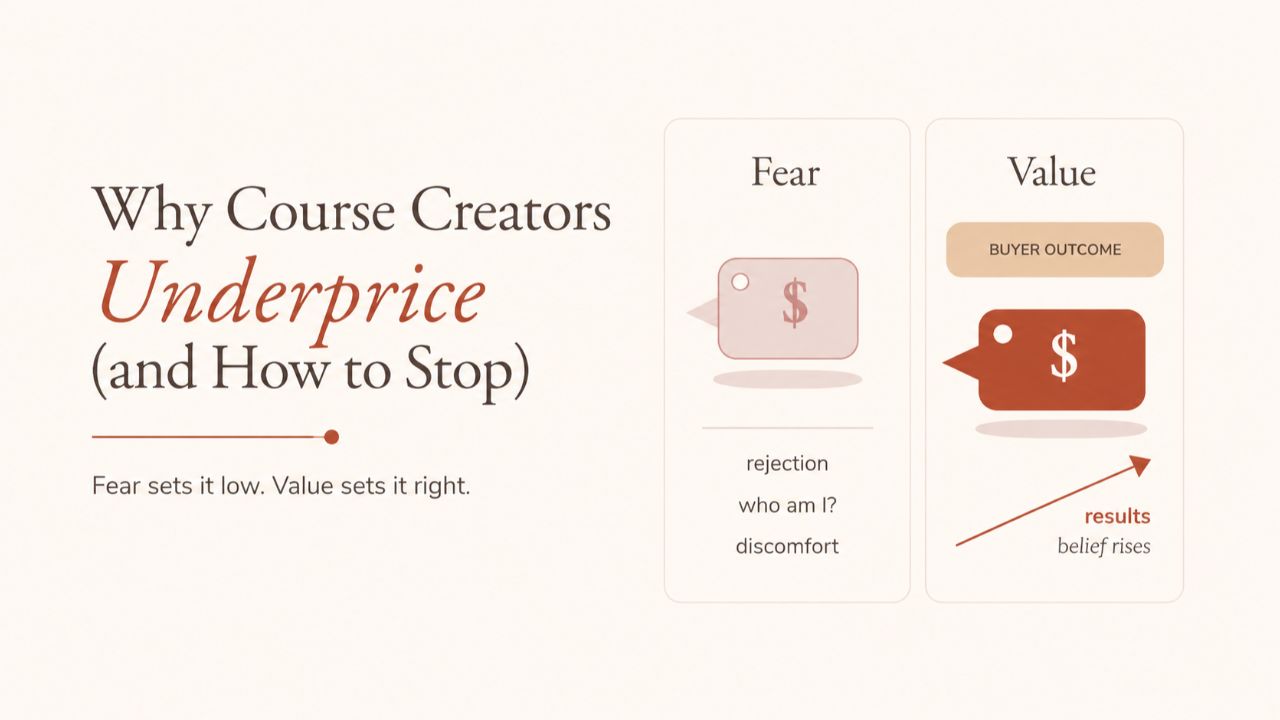
Course creators underprice mostly for emotional reasons, not strategic ones: fear of rejection, impostor feelings, discomfort with charging, and a belief that a low price is generous. A low price feels safe because it lowers the stakes of the ask, but that safety is expensive. It signals low value, attracts less committed buyers, and undercharges for the transformation you deliver. The way out isn't a pricing formula. It's recognizing that the discomfort you feel is fear rather than market feedback, anchoring the price to the buyer's outcome instead of your nerves, and raising the price deliberately despite the discomfort, using evidence of your results to rebuild your own belief.
This isn't about how to choose the number. That's the job of How to Price Your Online Course. This is about the harder part: why you can't bring yourself to set it higher.
The most expensive mistake feels like the safe one
Underpricing is the most common pricing mistake course creators make, and it's uniquely sneaky, because it doesn't feel like a mistake at all. It feels responsible. It feels humble. It feels generous. A low price lets you avoid the fear of a no, sidestep the discomfort of charging real money, and tell yourself you're being kind. Every part of it feels safe.
But the safe-feeling choice is the expensive one. While the low price protects your nerves, it quietly works against you and your buyers both. And because it never announces itself as a problem, it can persist for years, capping what your business earns and what your buyers actually get, without ever looking like the thing to fix.
The pricing mechanics, how a price signals value, how it filters buyers, how to land on the right number, are covered in the pricing guide. What that guide can't do is talk you past the feeling that stops you from acting on it. That feeling is what this article is about.
What's really happening when you set the price low
When you set a price lower than the value warrants, a few things are usually going on underneath, and none of them is about the market.
Fear of rejection. A lower price feels less likely to get a no. If you charge a little, more people say yes, and fewer make you feel the sting of turning you down. Setting the price low is emotional self-protection dressed up as a business decision.
Impostor feelings. The quiet question "who am I to charge that?" sets the price to what you feel worthy of, not what the outcome is worth to the buyer. When you don't quite believe you deserve to charge more, you price to your self-image instead of your results.
Discomfort with money. Many people carry a background belief that wanting money is a little greedy, that asking for more than the minimum is pushy. So they undercharge to stay in the comfortable zone where they don't have to feel that discomfort.
The belief that cheap is generous. The story that a low price is a gift to your audience. It feels virtuous, which is exactly why it's so sticky, and why it deserves its own look in a moment.
The thread running through all four is that the price got set by your feelings, not the buyer's value. The number reflects your fear, your self-image, and your discomfort, none of which has anything to do with what the transformation is actually worth to the person buying it.
Cheap protects you and costs you
Here's the trade you're actually making when you price low to feel safe. The low price protects your nerves in the moment, and in exchange it costs you in ways you don't see.
It signals low value, because buyers read a cheap price on a serious problem as a red flag rather than a bargain. It attracts less committed buyers, the ones more likely to refund and less likely to finish. And it undercharges for a real transformation. The full mechanics of how price signals value and filters buyers are in the pricing guide, but the short version is that the protection is real, the cost is bigger, and you pay it continuously: weaker positioning, worse-fit buyers, and a business that earns less than it should. The nervous system got what it wanted; the business paid the bill.
A low price isn't the kindness it feels like
The generosity story deserves special attention, because it's the belief that keeps good, well-meaning people underpricing the longest. "I'm keeping it affordable so I can help more people" feels genuinely kind. Who could argue with wanting to help?
But look at what a too-low price actually does to the buyer. A price so low it signals low value tends to attract people who are less invested, and less invested buyers are statistically less likely to show up, do the work, and finish. So the low price you set to help people often produces buyers who never get the result. You sold them something cheap that they didn't complete, which helped no one.
Real generosity looks different. It's delivering a transformation genuinely worth paying for, and pricing it so the buyer is invested enough to actually follow through. A buyer who paid a real price is more likely to show up and get the outcome, which is the thing you wanted to give them in the first place. Charging fairly for real value is more generous than charging little for a result nobody completes. Pricing well isn't the opposite of kindness. It's often the more useful form of it. You have permission to charge for what you deliver.
You undercharge because you can't see your own value
There's a specific trap worth naming, because it's at the root of so much underpricing: your belief about your own value lags far behind your actual results.
Here's how it works. You've helped people get real outcomes. But you discount your own part in it. "That was easy for me." "They probably would have figured it out anyway." So the thing that's genuinely valuable to your buyers feels ordinary to you, because you're standing too close to it. And you price from that internal feeling of ordinariness, not from the results you've actually produced.
The way out of this one isn't more confidence summoned from nowhere. It's external evidence. Your results, the actual outcomes people got. Your testimonials, in your buyers' own words, telling you what the work was worth to them. The early wins people got that they didn't expect. And what buyers say the outcome is actually worth, which you hear directly when you do voice-of-customer research. This is where proof does double duty: the same evidence that convinces buyers also rebuilds your own belief in what you're charging for. When you can see your value on paper, in other people's words, it gets much harder to keep underpricing it.
Raising the price despite the discomfort
Knowing why you underprice doesn't automatically fix it. Here are the moves that actually get the number up, and notice that none of them is a pricing formula, that part lives in the pricing guide. These are the mindset moves.
- Separate the feeling from the fact. The discomfort you feel about a higher price is fear, not evidence the price is wrong. Learn to notice "this feels scary" and stop treating it as "this is too expensive." They are not the same signal.
- Anchor to the buyer's outcome, not your nerves. When you set the number, think about what the result is worth to the person getting it, not about what feels comfortable to say out loud. The comfortable number is almost always the fearful one.
- Re-read your proof first. Before you set the price, go back through your results and testimonials. Rebuild your own belief on evidence before you decide what you're worth, so the number comes from your track record and not your self-doubt.
- Raise it for real, and sit with the discomfort. Make a genuine increase, not a timid nudge, and then don't retreat when it feels uncomfortable. The discomfort fades within days. The higher price stays. If you flinch and drop it back at the first pang, you've taught yourself that fear sets your prices.
- Expect the first sale to feel scary. The first time someone buys at the higher price, it will feel surreal, and then it will feel normal. That first sale is the evidence your fear was wrong.
- Climb, don't leap. You don't have to jump to your final number overnight. You can raise the price in steps as your results and confidence accumulate. Many creators raise prices repeatedly over a course's life, each time a little less scary than the last.
The most important thing to know is this: you will not feel ready. Waiting to feel ready is itself part of the trap, because readiness doesn't come before the raise. It comes after. You raise the price, the sky doesn't fall, and the new number becomes your normal. Readiness follows the action, not the other way around.
Common underpricing traps
- Waiting to "feel ready" before raising. Readiness follows the raise, not the reverse. If you wait for the feeling, you'll wait forever.
- Pricing to what you'd personally pay. You are not your buyer, and your own relationship to money isn't the measure of the outcome's worth.
- Dropping the price at the first hesitation. Retreating to the safe number the moment someone balks teaches you that fear runs your pricing.
- Using a low price to avoid selling. Pricing low so you don't have to persuade anyone is avoidance, not strategy.
- Competing on being the cheapest. A race to the bottom you can win only by earning the least. Being the cheapest is not a position; it's a trap.
- Treating your low price as your identity. A starting price is a starting point, not who you are. Let it rise as you do.
Where this sits
Underpricing is an offer-layer problem wearing a mindset costume. The number itself lives in the offer, where price expresses the value of what you've built, which is the subject of How to Build an Offer People Can't Ignore. But the block that keeps the number too low isn't in the offer. It's in your head. That's why a pricing formula alone rarely fixes chronic underpricing.
A mispriced offer can also look like other problems from the outside, slow sales that seem like a traffic or conversion issue, when the real cause is a price set by fear. If you're not sure whether your price is the thing holding you back, How to Diagnose Why Your Course Business Isn't Selling walks all seven layers in order, and Why Is My Online Course Not Selling? is the short way in.
The short version
Course creators underprice because of fear, impostor feelings, discomfort with money, and the belief that cheap is generous, not because of the market. The safe-feeling low price is expensive, and it isn't the kindness it feels like, since a price that signals low value serves buyers worse. Your belief about your own worth lags your actual results, so use your proof to catch it up. Then raise the price deliberately, anchor it to the buyer's outcome, sit with the discomfort, and let it climb as your evidence grows. You won't feel ready, and that's fine, because readiness follows the raise.
If you suspect your price is holding you back but aren't sure whether it's really the price or something else, the free Course Business Diagnostic helps find the actual layer.
Take the free Course Business Diagnostic
FAQ
How do I know if I'm actually underpricing? A few honest signals: warm, well-matched buyers say yes almost too easily, you feel a flush of discomfort or apology when you state your price, or people who get real results from you routinely tell you it was worth far more than you charged. If saying your number out loud makes you wince and want to justify it, that's usually fear talking, not evidence the price is right. The clearest tell is that your price is anchored to what feels comfortable rather than to what the outcome is worth.
Won't raising my price lose me customers? You may lose some, and often the ones you lose are the least committed, the buyers most likely to refund or never finish anyway. A higher price usually attracts more invested buyers, so the few you lose are frequently offset by better-fit customers and more revenue per sale. It rarely plays out as the pure loss the fear predicts. And if you're genuinely worried, you can raise it in steps and watch what actually happens rather than what you're afraid will happen.
How much should I raise my price by? That's really a mechanics question, and the reasoning for landing on a specific number is in the pricing guide. On the mindset side, the useful rule is to raise it by enough that it feels genuinely uncomfortable but still defensible against the value, rather than a timid nudge you won't even feel. A raise so small it doesn't scare you a little usually isn't correcting the underpricing.
What if I already have customers at the low price? You can raise the price for new buyers while honoring the old price for existing ones, which is common and fair. Grandfathering current customers, or giving them notice before a change, removes most of the guilt that keeps people frozen. Existing buyers at a lower price aren't a reason to keep underpricing forever.
Isn't a low price better for getting started or building an audience? A deliberate, temporary intro price to gather your first results and testimonials can be a reasonable strategy, as long as it's a conscious choice with an end date, not a permanent low price you've talked yourself into. The danger is that "just for now" quietly becomes forever, and the starting price hardens into an identity. If you start low on purpose, decide in advance what will trigger the raise, and then actually raise it when you get there.