When Are You Ready to Pay for Traffic?
Jul 29, 2026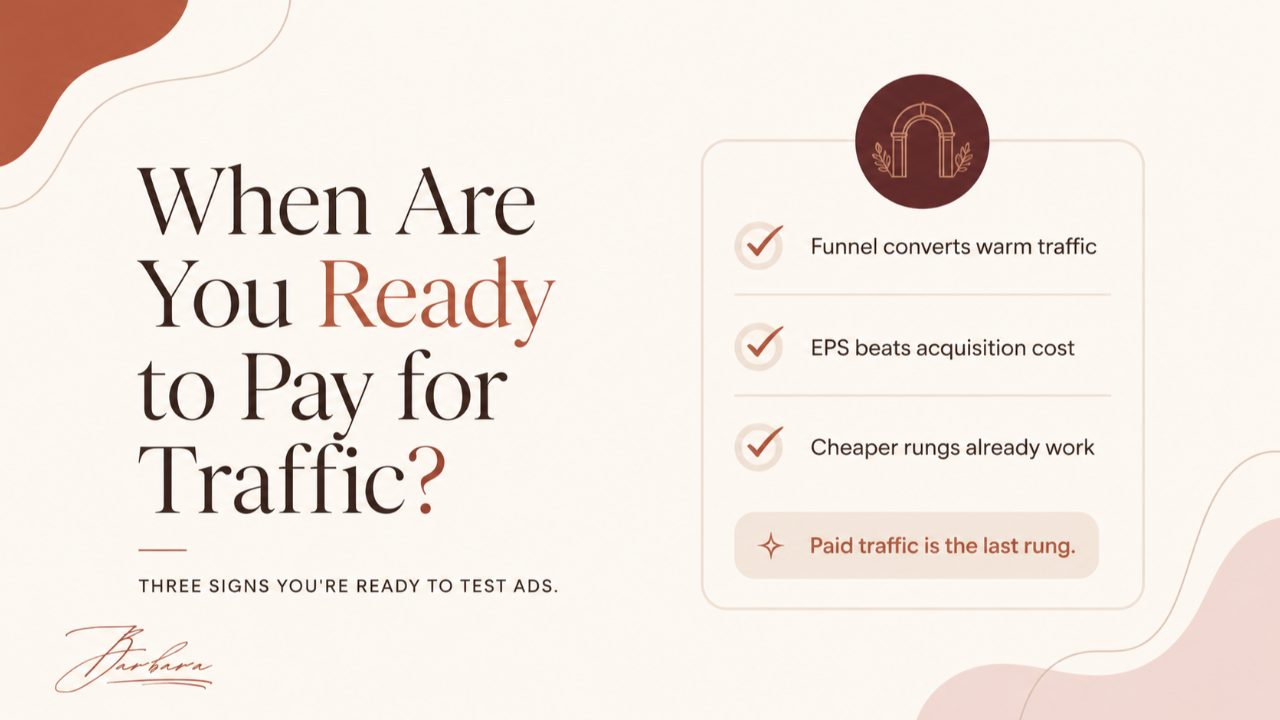
You're ready to pay for traffic when three things are true: your funnel already converts warm, free traffic at a reasonable rate at every step, a subscriber is worth more to you than it costs to acquire one, and you have the cheaper rungs, warm outreach and one organic channel, already working. If any of those isn't true, paid traffic loses money or is premature. Paid ads are the last rung of the traffic ladder, not a shortcut past a funnel that doesn't convert yet, and readiness is about the layers beneath traffic, not about the ads themselves.
That last point is the one worth holding onto, because it means the question "am I ready for ads" is really a question about everything underneath the ads. Let's make that concrete.
Paying too early is the expensive mistake
Paid traffic is the fastest way to spend money in a course business. That cuts both ways. When the funnel underneath is ready, ads pour fuel on a fire that's already burning. When it isn't, ads pour money into a leak, and they do it quickly, because you're paying per visitor to watch the same thing that was already failing fail at a larger scale.
So readiness is best understood as a gate that protects you. It's not there to slow you down out of caution for its own sake. It's there because crossing it too early turns a slow month into an expensive one, and because almost everything that makes ads work or fail was decided before a single ad ran. Traffic multiplies whatever the funnel already does, which is the whole argument of Why Traffic Is the Last Thing to Fix and Why More Traffic Won't Fix Your Funnel. This article is the follow-through: given that traffic is last, how do you know when last has actually arrived.
Three conditions have to be met. Here they are, in order.
First, prove it converts what it already gets
The most important condition is also the one people most want to skip: your funnel has to already convert the warm, free traffic it currently gets, before you pay for cold traffic.
Walk your existing visitors through the funnel and check each step. Do people opt in? Does the list engage once they're on it? Do warm people buy when you make an offer? Does the sales page convert the warm traffic that reaches it? If those rates are healthy on the free traffic you already have, that's the strongest sign the funnel can handle more. If any of them is broken, cold paid traffic will convert worse, not better, because paid visitors arrive colder and more skeptical than the people who already found you.
This is the same test as the traffic-versus-conversion fork, and if you haven't run it yet, Do I Have a Traffic Problem or a Conversion Problem? walks it step by step. If a step is failing, that's your real work, not ads: a cold list, a weak offer, a page that doesn't convert, or a lead magnet bringing the wrong people. Fix the failing step first. Ads will still be there when it converts.
Second, the per-subscriber math has to work
The second condition is economic: a subscriber has to be worth more to you than it costs to acquire one.
This is the earnings-per-subscriber gate. Compare what an average subscriber is worth to your business against what it would cost to bring in a new one through ads. If a subscriber is worth more than that cost, paid growth can make money. If a subscriber is worth less, every paid acquisition loses money, no matter how well you target or how much you spend. The full definition, how to calculate it and read it, is in What Is Earnings Per Subscriber (EPS)?, so I won't re-derive it here.
The decision it drives is blunt: if your EPS is below your cost to acquire a subscriber, you're not ready to pay for traffic, full stop. There's no targeting trick or clever creative that fixes negative economics. Get the per-subscriber value up first, by fixing the layers that turn subscribers into buyers, and then the math can support ads.
Third, you've climbed the ladder to this rung
The third condition is about sequence. Paid ads are the last rung of the traffic ladder, and you should already be standing on the rungs below them before you reach for it.
Those lower rungs are warm outreach and one committed organic channel. They should already be producing before you add paid traffic, for two reasons. First, they're cheaper, so it makes no sense to pay for what warmer, free channels can still give you. Second, and more importantly, them working is proof that your funnel converts real people. If warm outreach and organic content are bringing in subscribers who engage and buy, you have evidence the funnel works, which is exactly what makes paid traffic a reasonable bet rather than a gamble. The full ladder, warm outreach, one organic channel, borrowed audiences, then paid, is laid out in Why Traffic Is the Last Thing to Fix.
If you haven't worked the cheaper rungs yet, paid traffic isn't wrong forever, it's just premature. Climb the ladder in order.
The readiness checklist
Here's the whole thing as a check you can run on yourself. If every answer is yes, you're ready to test paid traffic. If any answer is no, that no is the thing to fix before you spend.
- Does warm, free traffic convert at every step? People opt in, the list engages, and warm people buy when you make an offer.
- Is a subscriber worth more than it costs to acquire one? Your EPS is comfortably above what you'd pay to bring in a new subscriber.
- Are warm outreach and one organic channel already working? You've climbed the cheaper rungs and they're producing.
- Can you afford to lose the test budget? Ads need a learning period, and some of that early spend is tuition, not profit.
- Can you track what an ad-driven subscriber actually does? You can see whether paid subscribers go on to engage and buy, not just opt in.
Notice that four of the five have nothing to do with ads themselves. Readiness is about the funnel beneath the ads, which is the whole point.
Starting small when the answer is yes
Say all five are yes. You're ready, but ready means ready to test, not ready to spend big.
Start with a small budget you can afford to lose, because the first stretch of any paid traffic is a learning period where you're finding out what works and some of the spend won't pay back. Then watch the thing that actually matters: whether ad-driven subscribers convert the way your organic subscribers do. They often convert worse, because they're colder and didn't seek you out, so an EPS calculated on organic subscribers can be optimistic for paid ones. Measure paid subscribers on their own terms, and only scale spending once the math holds up on paid traffic specifically, not just on the warm audience you already had.
Readiness, in other words, isn't a switch you flip to "spend big." It's permission to test carefully, with the funnel and the economics already proven underneath you.
Common mistakes with paid traffic timing
- Paying before the funnel converts warm traffic. If free warm visitors don't convert, colder paid ones convert worse. Fix the funnel first.
- Skipping the organic rungs. Jumping straight to paid means you never proved the funnel converts real people, so the ad spend is a guess.
- Assuming paid subscribers match organic ones. They frequently convert worse. Don't budget as if a paid subscriber is worth what an organic one is.
- Scaling on a tiny sample. A few conversions isn't proof. Give the test enough volume before you conclude it's working.
- Judging ads on opt-in cost alone. A cheap opt-in that never buys is expensive. Watch downstream sales, not just the cost per lead.
- Spending money you can't afford to lose during the learning period. The early spend is partly tuition. Don't bet rent on it.
Where this decision sits
This is the decision at the very top of the system, the last gate before you spend to multiply the funnel. It depends entirely on the six layers below converting and on the per-subscriber math reading positive. That's why nearly every part of the readiness check points downward, into the funnel, rather than at the ads.
If you want the layer this decision multiplies, it's the whole funnel beneath traffic; the number that gates it is earnings per subscriber; and the map of how it all connects is the full diagnostic. If the readiness check turns up more than one weak layer, What Should I Fix First in My Funnel? tells you which to repair first.
The short version
You're ready to pay for traffic when your funnel already converts warm free traffic, when a subscriber is worth more than it costs to acquire, and when the cheaper rungs are already working. Paid ads are the last rung, not a shortcut, and readiness is about the layers beneath the ads, not the ads themselves. When all three conditions hold, start small, measure whether paid subscribers convert like organic ones, and scale only once the math holds on paid traffic.
Not sure your funnel is ready for paid traffic? The free Course Business Diagnostic confirms every layer converts before you spend a dollar on ads.
Take the free Course Business Diagnostic
FAQ
How much should I budget for a first ad test? Enough to get a readable result, and no more than you can comfortably afford to lose, because the first stretch of spend is a learning period rather than reliable profit. There's no universal figure, since it depends on your acquisition cost and how many conversions you need before the numbers mean something. The safer framing is to treat the first test budget as tuition: set an amount whose loss wouldn't hurt, and expect to learn from it before you earn from it.
Do ad-driven subscribers convert as well as organic ones? Often not, at least at first. People who find you organically sought you out, while people who clicked an ad were interrupted, so they tend to arrive colder and convert at a lower rate. This matters because an EPS calculated on organic subscribers can overstate what a paid subscriber is worth. Measure paid subscribers separately, and don't assume they'll match your organic numbers until the data shows they do.
Can I run ads if I only have a small list? List size isn't the gate; conversion and economics are. A small list that converts well and has a healthy per-subscriber value can support ads, while a large list that doesn't convert can't. That said, a very small operation should usually exhaust warm outreach and one organic channel first, because those are cheaper and prove the funnel works before you pay to scale it.
Should I run ads to a lead magnet or straight to a sales page? Usually to a lead magnet first, because cold ad traffic rarely buys on the first visit, and capturing the email lets your funnel warm them up over time before asking for a sale. Sending cold traffic straight to a sales page tends to convert poorly and wastes the click. The lead magnet turns a cold ad click into a subscriber your email layer can then convert, which is what makes the spend pay back.
How long before I know if paid traffic is working? Long enough to get past the learning period and to see whether the subscribers you paid for actually go on to buy, not just opt in. That's more than a few days and usually more than a single opt-in report, because the real test is downstream sales, which take time to show up. Watch the full path from ad to purchase before you judge, and resist scaling on early opt-in numbers that haven't yet turned into revenue.